The YCC awarded the following 2025 prizes, which were approved by the Prizes Committee of the ASCL.
The images depict photos of current YCC board members Clare Ryan, Mortimer (Tim) Sellers, Yueh-Ping (Alex) Yang, and Alan Koh. Pictured also are Prof. Tim Sellers, ASCL Vice President, presenting the awards to Yuyan (Nicole) Zhang and Yinn-ching Lu.
Richard M. Buxbaum Teaching Prize for untenured law faculty in comparative law. Nominations for this prize were reviewed by the YCC Committee.
Dr. Soterios Loizou, Assistant Professor of Commercial Law, University of Cambridge, Faculty of Law
Dr. Loizou’s packet evinces a substantial record of excellence in teaching comparative law courses at a wide range of universities in Asia, Europe, and most recently in the UK. He demonstrates a passion and commitment to teaching students from diverse backgrounds and effectively deploying comparative methodology in commercial and business law. Notable accomplishments in teaching include being nominated for a university-wide excellence in teaching award every year from 2018-2025, and being accepted as a Fellow of the Higher Education Academy in recognition of teaching and service. The Prize submission included multiple testimonials from students, which emphasize Dr. Loizou’s engagement, humor, knowledge, and inclusivity in the classroom.
Phanor Eder Prize for the best paper written by a student in their first law degree. Submissions for this prize werew reviewed by the Membership and Engagement Advisory Group.
1st place: Yuyan Zhang, JD Candidate, Duke Law School, “Colonial Law and Contemporary Authoritarianism: Section 144 and Myanmar Military Junta”
Yuyan Zhang’s paper offers a powerful and timely analysis of how colonial-era laws — specifically Section 144 of the British Code of Criminal Procedure — are revived by contemporary authoritarian regimes to cloak political repression in legal form. Through detailed examination of Myanmar’s use of Section 144 before and after the 2021 military coup, Zhang demonstrates that colonial legal infrastructures not only persist but are strategically mobilized to serve autocratic ends. Drawing on the theory of autocratic legalism, the paper compellingly shows how legality itself becomes a tool of domination when inherited legal devices are reinterpreted and weaponized. The paper is well-structured, thoroughly researched, and grounded in close readings of both historical and contemporary legal texts.
Honorable Mention: Annalisa Kingsbury Lee, J.D. Candidate, Stanford Law School, “Legal Constraints in the Making and Un-Making of Regional Energy Systems in the US and China, 1963-1989”
This paper presents an original comparative legal-historical study of regional energy system development in the United States and China between 1963 and 1989. Challenging the assumption that central-local legal relations in these two systems are fundamentally dissimilar, Lee reveals structural parallels in how legal and institutional constraints shaped — and in some cases hindered — the formation of integrated electricity networks. The paper applies a functional institutionalist methodology, blending legal analysis with historical context and infrastructure studies to show how law operates not only as a constraint but also as a constitutive force in regional energy governance. . . it stands out for the honorable mention for its comparative ambition and conceptual clarity.
Colin B. Picker Prize for the best paper presented for the 2025 YCC conference by a graduate student. Submissions for this prize were reviewed by the Scholarship Advisory Group.
1st Place: “The Faces of Judicial Data Governance” by Leo You Li, JSD Candidate Stanford Law School
This Article offers a comprehensive and insightful analysis of judicial data governance across three major jurisdictions. The discussion is rigorously substantiated, with very clear comparative structure. The comparative method and the conceptualization of distinct models offer valuable insights into how varied legal cultures address challenges of transparency and utilization rules. … Overall, this work makes a significant contribution to understanding the complex landscape of judicial data management and offers practical guidance for future reforms. It is an excellent candidate for recognition as a prize-winning paper.
Honorable Mention: “Justices Matter: A Comparative Theory of Judicial Self-protection” by Yinn-ching Lu, SJD Candidate Emory University
This Article presents a very clear contribution, with a highly interesting subject and a solid comparative analysis of legal systems. The analysis flows seamlessly and is well-resourced, . . . the choice of Poland, Georgia, and Taiwan as comparative cases is particularly insightful, as these jurisdictions are underrepresented in current English-language legal literature yet share significant similarities and values. This Article enriches our understanding of how institutional arrangements—particularly in judicial appointment processes—impact courts’ ability to self-protect. . . Overall, this research provides valuable guidance for safeguarding judicial independence in challenging political environments and merits recognition as an honorable mention.
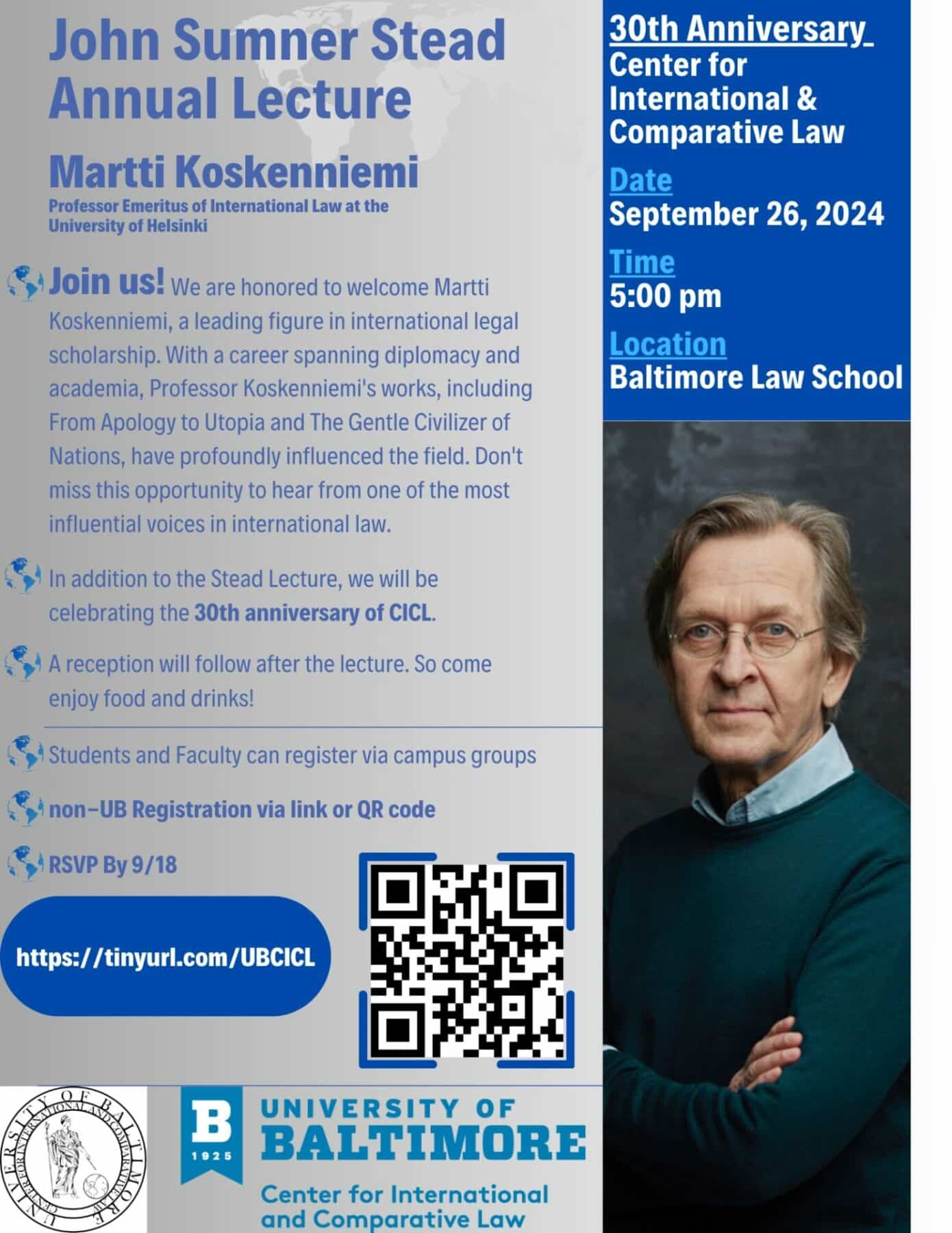
Martti Koskenniemi giving the John Sumner Stead Annual Lecture at the University of Baltimore School of Law
RSVP by September 18th at: https://www.eventbrite.com/e/john-sumner-stead-annual-lecture-speaker-martti-koskenniemi-tickets-1002725056637?aff=oddtdtcreator
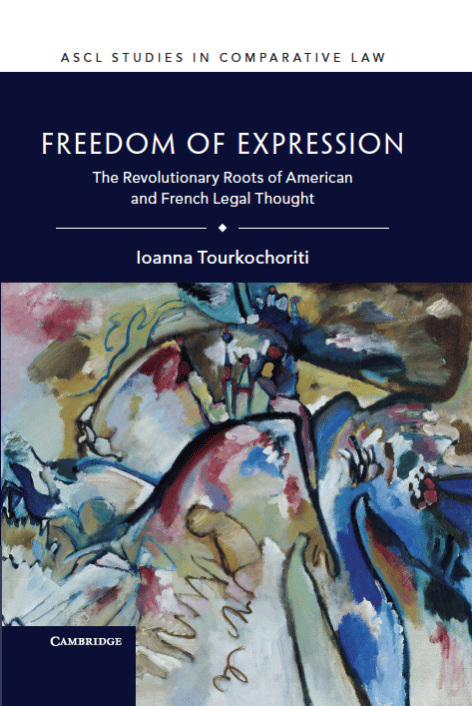
Freedom of Expression: the Revolutionary Roots of American and French Legal Thought
ASCL blog post
The book “Freedom of Expression: The Revolutionary Roots of American and French Legal Thought” (Cambridge University Press, ASCL Studies in Comparative Law, 2022) by Ioanna Tourkochoriti discusses the difference in the protection of freedom of expression in France and the United States. It compares French and American law on freedom of expression and suggests reasons why two legal systems founded upon similar philosophical and political background, the European Enlightenment, use state coercion differently to regulate a liberty at the core of the Enlightenment. In the United States, the legal protection of freedom of speech trumps the protection of other values, a sign of American exceptionalism. By contrast, in France limitations to freedom of expression are legitimate in order to protect other competing values. Some examples discussed in the book are hate speech, headscarf bans, political campaign funding.
Scholars in the US have proposed various interpretations on why this legal system protects speech so strictly. Some scholars discuss the emergence of a public consciousness for protecting free speech as having occurred after the end of the First World War. Others associate the emergence of the free speech doctrine with the Civil Rights movement. Some others have most recently associated it with the class war and the compromise between various social and political actors that emerged in the 20th century around the New Deal. This book complements these theories by arguing that the developments in the United States in the middle of the 20th century became possible due to a conception of the role of the government dominant during the Founding Era. These theories do not assist our understanding of why from a comparative perspective the United States has arrived at protecting speech more rigidly than other democracies which had to handle similar conflicts between political and social interests. It is a profound tradition on the role of the government and a narrative about the meaning of liberty that the American Supreme Court expressed in the 1960s when it issued its important decisions protecting speech. When government intervention in the economy became acceptable in the United States, the spirit of distrust towards the government dominant during the founding era found expression in the protection of freedom of expression. The book discusses the progressive-era scholars’ ideas on freedom of speech and shows that they won over to the extent that they resonated with the distrust towards the government dominant during the founding era.
The book argues that we can understand the divergence in the balancing of freedom of speech and other values in reference to the broader historical, social and philosophical context where jurists operate. We can trace the difference back to the two revolutionary traditions. The book is a study in comparative political and constitutional theory analyzing how theories of government were read and understood in France and the United States at the time of the founding of the two democracies. It also takes into account how these ideas evolved through the centuries.
If we approach the topic of freedom of expression from the perspective of comparative philosophy of history and legal philosophy, three important concepts are at stake. The concept of government, the concept of republicanism and the concept of natural rights. First, what is at stake is a profound difference in the understanding of the role of the government, on the imaginary level. In the United States, it is rarely legitimate for the government to intervene as the regulator of interpersonal respect for harm caused by speech. Second, the subtle nuances in the understanding of republicanism between the two systems are also relevant. In the US, the common good is defined in reference to the need to protect negative liberties. The dominant conception is that the political sphere is instrumental to the private sphere. In France, negative liberties are protected only to the extent that they are compatible with the common good. The common good is something qualitatively different. The quality of being a citizen is primary. The Rights of Man make sense only as Rights of the Citizen. Third, another important concept which is relevant to this discussion is the concept of natural rights. Natural rights discourse emerged in America shortly before the Declaration of Independence to delegitimize attempts by the British Parliament to enact legislation limiting the negative liberties of the people in the colonies. In France, the debates among the participants in the National Assembly during the Revolution indicate that they saw rights as natural because they also saw society as natural also. They saw society as having the mission to help the citizens realise their rights. These considerations are relevant to the legitimacy of the government to define the content and the limits of freedom of expression.
The purpose of this analysis in comparative legal philosophy is to encourage reflection on the proper limits to freedom of expression. The US may be overprotecting freedom of speech in some respects and France may be underprotecting the same freedom. Understanding the ideologies behind the emergence of a legal regime protecting speech does not mean accepting historical determinism. It is possible to think critically about just criteria for limiting speech. Principles and rules elaborated in the past to meet concrete socio-political needs may not be relevant today to address contemporary concerns related to limiting rights. The book engages with contemporary debates on hate speech, the protection of privacy, headscarf bans and political campaign funding and proposes criteria for government intervention to limit expression or not in these cases.