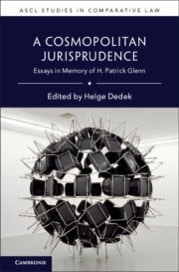
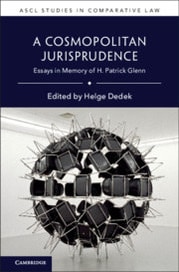
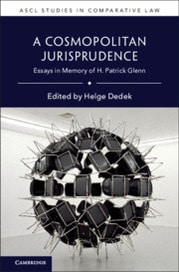
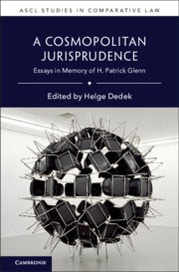
Mindful of the World: “A Cosmopolitan Jurisprudence”
[Editor’s note: this is the final of four blog posts featuring the volume “A Cosmopolitan Jurisprudence: Essays in Memory of Patrick Glenn”, edited by Helge Dedek, Cambridge University Press, ASCL Studies in Comparative Law, 2022]
It has been a long journey from the first tentative ideas to the publication of this collection in memory of an esteemed colleague and beloved friend. The first working title for the collection, alluding to Patrick Glenn’s indefatigable idealism, was “Sustainable Diversity in Law” – borrowed from the original subtitle of his book Legal Traditions of the World that Glenn himself dropped in later editions. However, along the way one specific theme gained prevalence, namely that Glenn’s ideas went beyond targeting the traditional comparatists’ fixation with state law but ultimately sought a novel way of thinking about law writ large: the bold ambition to conceptualize law entirely through the experience of plurality and diversity.
For Glenn, “Comparative Law” was the inevitable disciplinary home to develop such a pluralistic vantage point, a mode of thought accessible to those who defy being intellectually circumscribed by only one national tradition, one methodological framework, one value system. Embracing the relativity of perspective would open the possibility of recognizing oneself in the Other and would pave the way to an understanding of “comparison” beyond traditional “comparative” analysis. The aim was thus eventually, as Glenn put it, a “cosmopolitan legal theory” that would hold up a mirror to conventional legal thought, and “play the role of a ‘critical theory’ in presenting alternatives to current forms of normativity, whatever their forms” [H.P. Glenn, Differential Cosmopolitanism, 7 Transn’l. L. Theory57, 69 (2016)].
This fundamental challenge to methodological nationalism might just be the most thought-provoking aspect of Glenn’s work, and potentially the most relevant to the many ongoing similar discourses across various disciplines. This ambition and audacity to think about law differently, in a genuinely “cosmopolitan” way, inspired the collection’s eventual title: “A Cosmopolitan Jurisprudence.”
In this context, (cosmopolitan) “jurisprudence” seemed the more fitting label than that of a “theory.” While we associate, in casual usage, “jurisprudence” with any kind of scholarly treatment of law, the semantics of prudence and prudentia are historically connected to a scholarship that is characterized by learnedness and judiciousness – the reigning paradigm of legal scholarship until it began to be replaced by scientia, science, as the paradigm for all university disciplines. In addition, prudentia, used to translate the Greek “phronesis,” has traditionally been tied in Western philosophy to forms of intuitive, practical wisdom, gained from experience [see e.g. D. Randall, The Prudential Public Sphere 44 Philosophy & Rhetoric 205 (2011)]. Glenn’s intellectual trajectory was that of someone trained in the law who felt compelled to step outside traditional disciplinary boundaries by the actual experience of diversity and otherness, experience gained as a comparatist and traveller of the world. Intellectually, he was an avid traveller as well: uniting shards and pieces from various works and disciplines into an original pluralist mosaic that made sense of this experience. It comes to mind that, as Ulf Hannerz [Cosmopolitans and Locals in World Culture, 7 Theory, Culture & Society237, 239 (1990)] once observed, “cosmopolitans should ideally be foxes rather than hedgehogs.”
The visceral appeal of such “phronetic wisdom” is probably one of the reasons why the metaphoric reference to art, especially the piece “Black Whole Conference” by Montreal artist Michel Le Broin, eventually took on such a prominent role in my own introductory chapter. Of course, as we all know, another aspect of this unconventional nature of Glenn’s work was that it was open to criticism on many fronts, and that critics at times were harsh in their judgment. It seems to me, however, that it is particularly this quality of triggering the urge to voice disagreement, this “irritating” quality that will keep fuelling important conversations and inspiring other unconventional ideas. Accordingly, the collection was never intended as a hagiography but as a respectful yet critical engagement with Glenn’s ideas – in other words, as the continuation of the kind of intellectually honest conversation that Glenn himself enjoyed so much in his lifetime [cf. A. Halpin, The Application of Bivalent Logic, and the Misapplication of Multivalent Logic to Law, in H.P. Glenn & L. Smitheds, Law and the New Logics 208 (2017)].
I believe, for example, that Glenn’s focus on the concept of “tradition” is an extremely valuable stimulus to further explore and take more seriously the discursive characteristics of “law”, shifting the perspective onto the historicity of the methodological nationalism in law itself – a move that allowed Glenn to speak, counter-intuitively perhaps, of the state itself as a tradition.
However, I find unconvincing that, in their anti-statist and anti-positivist thrust, Glenn’s ideas mostly tune out the dimension of law as power, as force, as violence. In Glenn, this is not just a matter of analysing “law” from a particular perspective that sheds light on its discursive nature in a way that positivistic or sanction-oriented theories of law will not. Rather, Glenn derives an odd normative twist from the analytical finding that each tradition is, essentially, communication: “communicative action” as such can navigate and overcome conflict. For Glenn, introducing the tradition-concept itself thus creates an epistemological framework for the (re-)conciliation of, and between, traditions. Traditions are, due to their communicative structure and nature, by definition “commensurable” and thus open to dialogue [on another aspect of this normative bend, cf. M. Krygier’s blog entry Thinking too well of traditions].
Yet in a global order characterized by a post-colonial hegemonic hierarchy, the challenge of (re-)conciliation presents itself specifically against the backdrop of a history of injustice and violence, and in the context of conditions of inequality in which recognition of the non-hegemonic tradition is never fully realized. The bias against acknowledging the role and presence of violence in all of legal discourse ultimately manifests itself in a lack of sensitivity towards the epistemic violence inevitably implied in the assumption of “commensurability.” That is at least the case as long as it is not acknowledged that the “common measures” upon which “commensurability” is predicated, (that is, the ‘universal’ language and the concepts that determine the framework of commensurability) typically are those imposed by the hegemonic tradition [see e.g. J. Tully, Strange Multiplicity: Constitutionalism in an Age of Diversity 39 (1995)].
Going forward, a “cosmopolitan jurisprudence” (or even “cosmopolitan critical theory”) will have to acknowledge that certain non-Western, especially Indigenous traditions, completely elude Western imagination and verbalization. As Canadian Indigenous scholar Aaron Mills has suggested, an assumption not of universalizing commensurability but rather of radical incommensurability might be therefore the truest form of recognition [see A.J. Mills, Miinigowiziwin: All that Has Been Given for Living Well Together: One Vision of Anishinaabe Constitutionalism, 45 (2019)].
However, despite its flaws, Glenn’s “cosmopolitan jurisprudence” was based on the uncontestably right intuition: to necessity to challenge the methodological nationalism in law that is such a strange anachronism in our global age. Phronesis/prudentia, suggested another unconventional thinker concerned with breaking down boundaries between traditions [Thomas McEvilley, The Shape of Ancient Thought 609 (2002)], could also be translated as “mindfulness”:if Glenn’s jurisprudence has contributed, even just a little bit, to making us more mindful of this necessity, to making us jurists more mindful of the world, we are all better for it.
Thinking Too Well of Traditions
[Editor’s note: this is the third of four blog posts featuring the volume “A Cosmopolitan Jurisprudence: Essays in Memory of Patrick Glenn”, edited by Helge Dedek, Cambridge University Press, ASCL Studies in Comparative Law, 2022]
Often the words we use are at the same time commonplace and weightless; we are comfortable using them and they loosely, often usefully, direct the flow of verbal traffic one way or another along paths we and others can understand. But they commit us to little. ‘Tradition’ is commonly mentioned in that way: something to do with things handed down from the past, but not much more.
Sometimes, however, when taken up by a stringent thinker, the same words get content and depth; at their deepest they come both to embody a theory, or at least a considered view, and contribute in specific, even unsubstitutable, ways to larger theorising. Think Marx on class, or Weber on bureaucracy. In Patrick Glenn’s prolific and wide-ranging contributions to comparative law, ‘tradition’ becomes such a concept.
Glenn was dissatisfied with the standard taxonomic characterisations of law into systems, cultures, families, nation-states, etc. He emphasises the indispensable, ineradicable, normative presence of the past in law, and thus rejects temporally and otherwise parochial ‘time-slice’ characterisations of ‘legal systems’ or ‘cultures’ and such, which suggest that they all might have started yesterday or that it wouldn’t matter if they hadn’t. He is hostile also to post-Western-Enlightenment slightings of the traditional sources of form and content in societies and legal orders, modern as much as those relegated to benighted, custom-dominated, ‘pre-legal’, ‘traditional’, pasts, or presents in ‘less developed,’ usually southern, climes.
For Glenn, the traditionality of law is key, and he is surely right. In almost every legal ‘system,’ the maintenance of a normatively present past is attended to with a diligence matched only in institutionalised religions. This is no accident. In law, traditional inheritances are the unreflected-upon context and medium of reflection, imagination and action. What these present-pasts are made up of – statutes, interpretations, court judgments, the opinions of scholars – differs greatly among legal orders. Overarchingly, particular forms of what Clifford Geertz calls ‘legal sensibility’ also endure within traditions and differ, sometimes dramatically, between them. The pervasiveness of such pasts, both real and imagined, their architectonic significance in the present of law, can scarcely be exaggerated.
Analytically (and legally and sociologically), then, Glenn’s is a profound and enriching insight, and he is profoundly attached to it. But as often happens with iconoclastic enthusiasts, at times his fondness for his subject overreaches. For he attributes virtues to traditions, ontologically as it were, that are not always there or theirs.
Glenn sets a lot of store by a quite specific narrowing of what counts as legal tradition: it is past informationand nothing more. That is important because information is available to anyone, does not exclude others as ‘systems’ and ‘cultures’ do, is open for appropriation all over time and place. As Glenn writes, information ‘does not control legal practice. It is tolerant of argument … while allowing peaceful resolution of disputes,’ ‘tradition conceived as information has no borders’ ‘the flow of information is ultimately uncontrollable; closure is never complete.’ He introduced the attractive metaphor for legal tradition of a ‘bran-tub’; reach in and choose your prize.
But tradition is always more than mere information. Members of traditions never simply choose between the bits of information that come down to them. In a real sense, as Gadamer has written, we ‘belong to elements of tradition that reach us.’ For, beyond the information they transmit, traditions, particularly institutionalised ones like law, are managed by traditionally authorized guardians concerned that some things be in, some out; some normative, others just simple information; some information, others just noise. And if I am a judge in a legal tradition, or a citizen in search of a result, I hope the law is not random information. I want to be able to know it when I need to. Where things work as they should, many legal practices are designed to make that possible. Of course it’s not a simple matter, and there is always room for interpretation, but if it’s a lucky dip we’re in bad shape legally. And when the law is not as I believe it should be (for reasons traditions say a lot about), I or someone is likely to be involved in trying to ‘massage’ (Glenn’s term) the material to have it interpreted one way or another, implemented one way or another, taken more or less seriously as a normative element in their life-world. If all this sort of work is not happening to the ‘information’ in a tradition, you don’t have a tradition; just information. For imposed ways of handling (including ‘massaging’) traditional information are not just unavoidable ‘corruptions’ of traditions, which Glenn acknowledges. They are constitutive parts of their nature.
Tradition, then, is never ‘simple’ information. Being normative it is always ‘information plus’ and the ‘plus’ does a lot of work. That being the case Glenn’s beguiling images of free-flowing rivers or randomly assembled and chosen bits of information in a bran tub, which might make plausible Glenn’s contrasts between inherently borderless traditions and hermetically sealed systems and cultures, is overdone and does not support the congenial characterization he draws from them.
Nothing in the nature of traditions tells you how they will behave; it is as little contrary to their nature to be hostile to other traditions, or to sects and heretics within the great traditions as it is to be tolerant of them. As Glenn himself notes, ‘Tolerance is not easy, which may be why there is a tradition of intolerance.’ (Glenn, Legal Traditions of the World, n.5, 53). Indeed there is; indeed there are. Many, and their lives have been long. I doubt that even the most skilled massaging of the concept of tradition is likely to end that any time soon.
None of this undercuts the significance of Glenn’s contribution. We should acknowledge that law is typically founded on and in traditions, simply because that is a fact, and an important one. We can also learn much from his learned, bold, wide-ranging and bold application of the concept and exploration of the phenomena. I fear, however that to acknowledge these virtues will do little to advance the accommodations among traditions that Glenn admirably favours. Nor does it necessarily block them. They still have to be promoted on independent grounds, not because to act conflictually or exclusively or arrogantly in relation to other legal traditions is in some way to betray (or corrupt), or for that matter to honour, the very nature of legal tradition itself.
Nothing in the nature of traditions tells you how they will behave; it is as little contrary to their nature to be hostile to other traditions, or to sects and heretics within the great traditions as it is to be tolerant of them. As Glenn himself notes, ‘Tolerance is not easy, which may be why there is a tradition of intolerance.’ Indeed there is; indeed there are many, and their lives have been long. I doubt that even the most skilled massaging of the concept of tradition is likely to end that any time soon.
Thinking well of traditions
[Editor’s note: this is the second of four blog posts featuring the volume “A Cosmopolitan Jurisprudence: Essays in Memory of Patrick Glenn, edited by Helge Dedek, Cambridge University Press, ASCL Studies in Comparative Law, 2022]
The most controversial theoretical contribution to comparative law by the polymathic Patrick Glenn in his LegalTraditionsof theWorldwas his effort to get us to think well of tradition(s). For him, the key to tradition is the idea of information, that which is brought from the past to the present, in a particular social context. It can include stories, concepts, beliefs, facts, symbols, values, political theories, heuristics and, if not actual institutions, at least ideas about institutional objectives, design and significance. The variety of information captured will increase as the tradition increases in size, each generation capturing its own understanding of the tradition. The pool of information captured by the adherents of a particular tradition cannot be entirely controlled, but a tradition stays alive through massaging i.e.- by being called on selectively (the massage is the message?) Above all, however, for Glenn, legal traditions do, can and should respect each other. Elaborating this argument was part of a project of building what he called ‘sustainable diversity in law’, a necessity for the peaceful coexistence of different ideas and peoples.
Realising such an aspiration is increasingly urgent as so many groups are currently reacting to globalisation by (re) emphasising connections with the past and appealing to supposedly long-standing distinctive religious and national bonds and identities. But it begs a series of questions. How far can tradition help to facilitate necessary changes rather than stand in their way? What happens to those who challenge tradition? When do traditions in fact respect each other, when do they instead seek to predominate?
Glenn tells us that major traditions achieve complexity because of their proven ability to hold together mutually inconsistent sub-traditions. Butif it is intuitively plausible to think that the complexity of tradition makes necessary a tolerance of potentially conflicting ideas, at least some of the time, it is less obvious that the same applies to the relation between traditions. Glenn admits that a tradition can take specific measures to protect its underlying or basic elements, using means that range from a simple ethical obligation to remember, to instruments variously known as heresy, treason, or sedition. But he asserts nonetheless that the authority of tradition is persuasive only. It allows for dialogue and normative engagement, as opposed to hierarchical dominance.
Some of Glenn’s claims may depend more on definitional stops than on empirical findings. But if we are to make progress in assessing them (and further his admirable goals) we require more case studies of how in practice different traditions manage continuity and change, and the ways in which they deal with (other) internal and external challenges. One example of reconciling continuity and change under changing social circumstances is offered by the way the Jewish law tradition (one of those examined in detail by Glenn) revoked and/or reinterpreted the strict biblical rules about the cancellation of loans every seven years. The rabbis, following the suggestion of Hillel, crafted a loophole by introducing a document -the Pruzbul- that would accompany interest-free loans, stating that such loans were to be transferred to the courts. As the law of remission does not apply to loans within the public domain this ground-breaking institution benefited both borrowers and lenders. It meant that borrowers would still be able to access loans because lenders knew their money would be safe despite the arrival of Sabbatical year.
The issue- much fought over by different streams within Jewish tradition- is by what right Hillel sought to circumvent what appeared to be a clear Biblical prescription (one accompanied by a warning that people should not refrain from lending even if they knew they would not be repaid). The more conservative answer explains that, because of changes in where Jews were living at the time of Hillel’s ruling, the Biblical requirement to cancel debts was no longer binding. It was now only supported by Rabbinical authority and hence could be amended by that same authority. More, the change was intended to privilege the higher level-Biblical – necessity to ensure that loans continued to be forthcoming. More radical commentators tend instead to take Hillel’s action as an example of bold willingness to update tradition in the light of changing social needs. They treat his innovation as a purported precedent for similar bold interventions on other fronts which in their view are now crying out for reform. As for traditions being mutually respectful, for outside observers, the exact basis of Hillel’s action is less significant than for insiders. Depending on the starting points of rival traditions, they can be less than generous to this innovation – for example preferring to highlight the persistence of different rules about lending on interest to insiders as compared to outsiders. For some, Hillel’s creative skill in renewing the past in the present is characterised as Rabbinical casuistry in the service of proto capitalism.
Legal Monotheism and Its Discontents
[Editor’s note: this is the first of four blog posts featuring the volume “A Cosmopolitan Jurisprudence: Essays in Memory of Patrick Glenn, edited by Helge Dedek, Cambridge University Press, ASCL Studies in Comparative Law, 2022]
Patrick Glenn’s scholarship does not introduce a ‘concept of law’ or explicitly criticize the concepts of others. Yet, he trusts the findings of a long line of legal anthropologists (and a shorter one of comparative law scholars) showing that in non-Western traditions, there is no distinct line between legal and non-legal forms of normativity (Legal Traditions of the World: Sustainable Diversity in the Law, 5th edn, OUP 2014, 60–94, 98–129, 180–215, 287–315, 319–56). Yet, the method and tools Glenn relies on can be used to look into the Western legal traditions too.
In the West, political and legal theories have long been taking for granted the idea that law is the province of government and government recognized authorities, including the judiciary. They have concentrated on the processes and principles, by which the form and substance of official (State) law are determined, implemented, and enforced. By contrast, many non-official sites of legal production have always existed and still exist (outside and) inside the West. These sites produce rules that may flourish indifferent or in opposition to official law and take the settlement of disputes arising out of the application of those rules outside the ordinary circuits of adjudication. Even though the discussions about the relation between the latter rules (especially those developed by merchants) and official law is one of the most ancient debates of the law, in the last two hundred years the Western positivist attitude has been able to obscure and fence off the multifaceted dimensions of the legal experience from the spotlight of critical investigation, from law schools and from legal textbooks.
The low visibility of these unofficial legal sets in the mainstream debate, however, should not obscure thesignificant effects they can have on social order—and on the efficiency of the concerned markets and dispute-solving mechanisms. Indeed, there are many field studies conducted in different sectors of social life and business activities, showing how in those sectors unofficial law reveals itself as the controlling factor of public and private behaviors. Examples may be drawn from fields as disparate as family, religion, religion-related food, rural communities, the enforcement of commercial contracts surveyed in the local, national and global dimension, concerning e.g. the markets of cotton, diamonds, grain and feed, the online environment, the financial law (M. Bussani, Strangers in the Law: Lawyers’ Law and the Other Legal Dimensions, 40 Cardozo Law Review 3127, 3146 (2019)).
Thanks also to these field studies, in the last decades the unofficial dimension of the law has gained new scholarly traction. Law and society scholars inquire into the social structures that induce compliance, law and economics scholars examine non-State law rules and institutions that allow for efficient and desirable social results, law and psychology scholars scrutinize the motivations that ground loyalty to non-State and State laws, and all (should) profit from the long trodden path of legal anthropologists and from their findings on the cross-cultural features of social ordering, as well as from legal historians’ studies on how private and commercial law has been thriving for ages in the absence of constitutions, almighty legislatures, and State courts orderings.
The overall lesson we should learn from the above scholarship and field studies is that overlooking the sets of unofficial laws we leave behind us a piece of the real legal world that survived to our ignorance in the past and will outlive our current disregard. Unofficial law asks lawyers to ‘stop, look, and listen’ as they approach the boundary of the official legal system. What is enmeshed in unofficial laws are in fact the multi-faceted fabrics of our society, the different existing views of looking at ourselves and the others, the manifold ways of unfolding our loyalties, our identities, and our professional, social, and cultural selves. If we keep looking down on the legal offspring of all this, we miss a cognitive dimension of the law, whose loss, among other things, should urge one to define herself not as lawyer, judge, or legal scholar, but as State-law lawyer, State-law judge, State-law scholar, and nothing more. This is one of the fallouts the battle of definitions about “what is law” carries with itself – a battle Glenn wisely avoided. Searching, debating, and setting borders functional to institutional arrangements that need to keep clearly separated State law from the rest, has proved successful in the last two/three centuries and is a culturally legitimate attitude. The latter’s matrix should be disclosed, though. It is grounded on a series of (neither transcendental, nor immutable, but) historically construed notions, and the refusal to acknowledge it, acting as the ministers of a legal monotheism, reveals nothing but a path-dependent, all-Western-centric, and certainly profitable (also in view of preserving an intellectual and professional status quo) way of looking at the “law.”
Taking stock of the foregoing also explains why a pluralistic, interdisciplinary perspective on law is much needed in order to seize the ways the laws both reflect and structure human relations. Among many other things, Patrick Glenn taught us this. Such a perspective would call into question common views of official and unofficial law, connecting mainstream visions about law within the broader social contexts where laws and justice live, and unveiling the different kinds of loyalties that underlie and support the choices of official and unofficial law mechanisms and actors. To delve beyond conventional wisdom and to better understand the legal dimension through the cultural, social, and professional frameworks in which the laws operate and are embedded, would be both this perspective’s promise and challenge.