The Accusatorial/Inquisitorial Divide and the Interplay of Nationalism and Universalism: A Response to Readers
[Editor’s note: This is the final of four posts for a mini symposium on Amalia Kessler’s article “Toward an Account of the Nineteenth-Century Emergence of the Comparative Accusatorial/Inquisitorial Divide“, The American Journal of Comparative Law, Volume 71, Issue 2, Summer 2023, Pages 296–327, https://doi.org/10.1093/ajcl/avad022]
My deepest thanks to Jean-Louis Halpérin, Máximo Langer, and David Rabban for their thoughtful reflections on my article. I cannot do justice here to all their rich questions, but it’s a pleasure to begin thinking about these.
The nineteenth-century rise of the accusatorial/inquisitorial divide was a transnational (and to a limited extent, transatlantic) phenomenon. Given space constraints, I chose to focus on developments in France, a country whose revolution and later wars of conquest played an important role in shaping these transnational debates. The danger of this choice is unintentionally to imply a centrality to French developments. Both Halpérin and Langer correctly state that the French experience must be contextualized with a broader frame. Halpérin notes that, as compared with Carmignani and especially Mittermaier, Ortolan and Hélie were relative unknowns, much more influential in France than elsewhere. And Langer observes that the nineteenth-century construction of the comparative accusatorial/inquisitorial divide was in fact “a gradual process,” dating back to eighteenth-century efforts to distinguish between English and continental modes of criminal procedure.
These are important points, and it would be wonderful to see further research exploring these themes, including Langer’s exciting forthcoming book. That said, as Halpérin comments, there was a distinctive national valence to how the universal categories of accusatorial and inquisitorial were deployed. There is therefore much to be learned from mapping out (and ultimately comparing) these distinctive national pathways. My hope is that my article can contribute to this broader, collective project. So too, while the nineteenth-century emergence of an accusatorial/inquisitorial framework was rooted in earlier developments, it is important to explore what precisely was unique about the new framework. Indeed, the very fact that nineteenth-century jurists felt compelled to create this new framework indicates that they believed it served purposes that an older approach did not.
Langer suggests that, from the perspective of jurists like Ortolan and Hélie, one virtue of the new framework was that it facilitated French nationalism. In contrast to an earlier distinction between English and continental models of procedure, which tended to valorize the former, the new accusatorial/inquisitorial framework (and the concomitant conception of the French system as mixed) made it possible to identify the French model as superior. As I discuss elsewhere, Mittermaier pursued much the same nationalist project in Germany—one deeply connected to his Germanist vision of liberal nation-building. He thus insisted that, while England had come closest to adopting a pure model of accusatorial procedure, such procedure could be found in many different times and places (in the West), including not least, in medieval Germany prior to the reception of Roman law. (Kessler, “The American Importation of the Accusatorial/Inquisitorial Divide: Francis Lieber’s Failed Transplant and Its Early Twentieth-Century Resurgence, in The Learned and Lived Law: Essays in Honor of Charles Donahue (forthcoming, Brill’s Legal History Library, 2025).) But the power of the accusatorial/inquisitorial framework—for not only analytical, but also political purposes—was that it couched such nationalism in the language of universalism. It suggested, in other words, that it was mere happenstance that comparative analysis pointed to the superiority of the jurist’s own nation, presenting such superiority as an outgrowth of the particular juncture at which the nation found itself at that moment in the universal, historicist process of national unfolding.
The complex (and seemingly contradictory) interrelation of nationalism and universalism facilitated by the accusatorial/inquisitorial framework is also evident in the ways that nineteenth-century jurists built this framework. As Halpérin notes, these “comparative pioneers” engaged extensively with one another, developing shared ideas and categories, even while deploying these toward nationalist ends. If we are to explain this phenomenon, important weight must be given to the historicist nature of their analysis. The tension between the universal and the national was inherent in the model of history that these men adopted in that the embrace of certain purportedly universal historical laws made it possible to compare different nations according to their stage of evolutionary development.
If this effort to meld nationalism and universalism seems to us today to be at best muddleheaded, or at worst a fig leaf for imperialist ambitions, it is worth considering how much has changed. Prevalent functionalist approaches to comparative law presume that societies (at least those at a roughly similar developmental stage) have common needs to which the law must respond. In this respect, functionalism would appear to stand in for discredited stadial accounts of history. And to the extent that the identified social needs happen to be consistent with the interests of the powerful, the imperialist valence persists. It is perhaps in this context that we should consider Langer’s important observation that a key part of the enduring appeal of the accusatorial/inquisitorial framework today is that accusatorialism has inspired significant procedural and judicial reforms, including especially in Latin America. A substantial literature debates the reasons for the Latin American embrace of accusatorial procedure, with many suggesting that the ostensibly universal category of accusatorialism has been deployed in service of a soft imperialism, enabling interests in the Global North to pursue their own agenda in the Global South. Langer himself has done important work countering this perspective and highlighting the role played by Latin American lawyers and activists in pressing for accusatorial reforms. (Langer, “Revolution in Latin American Criminal Procedure: Diffusion of Legal Ideas from the Periphery,” American Journal of Comparative Law 55 (2007): 617-76.) But whatever the underlying motivations behind the reforms, they have, as Langer notes, proven disappointing to many, failing to deliver the hoped-for political, efficiency, and other benefits. While there are many reasons for such disappointment, one factor is likely the mismatch between ostensibly universal categories and more particular, national interests and agendas.
This mismatch between the national and the universal is also evident in Halpérin’s powerful observation that, strangely, Ortolan and Hélie did not focus attention on what would seem today to be key distinguishing features of French criminal procedure—namely, the creation of the public prosecutor and the role assigned to the private complainant. This choice to ignore the law in action cannot be attributed to these scholars’ distance from legal practice, since both practiced law for years, and Hélie became a judge, rather than an academic. Were they so in thrall to German legal scholarship and a universalizing conception of legal-historical development that they were unable to depart significantly from Mittermaier’s model? Perhaps—but before reaching this conclusion, I would like to know more than I currently do about contemporary French debates regarding the public prosecutor and the role assigned private complainants. It might well be the case, in other words, that Ortolan and Hélie’s silence was in itself a statement about the national legal and political context.
Rabban situates my account of the emergence of the comparative accusatorial/inquisitorial framework in France against his own fascinating research into how nineteenth-century American jurists viewed the relationship between law and history. He asks about possible parallels between French and American approaches to legal history in this period, as well as the extent to which French scholars engaged with “colleagues abroad.” A full response to these questions would require a book comparable to Rabban’s own, which to my knowledge, has yet to be written. (Rabban, Law’s History: American Legal Thought and the Transatlantic Turn to History (Cambridge: Cambridge University Press, 2012.) Halpérin and his co-author, Frédéric Audren, touch at times on nineteenth-century French jurists’ uses of history in La culture juridique française: Entre mythes et réalités, XIXe-XXe siècles (Paris: CNRS Éditions, 2013). And Donald R. Kelley’s Historians and the Law in Postrevolutionary France (Princeton: Princeton University Press, 1994) explores the interrelation of nineteenth-century French lawyers and historians. But neither of these excellent books provides a systematic account of how French jurists in the period understood historical change. That said, my sense is that there were in fact many parallels between the ways that nineteenth-century American and French lawyers conceived of law’s history. Like their American counterparts, French jurists were profoundly influenced by the German Historical School and viewed themselves as engaged in a broader transnational conversation. The French journal Thémis, established in 1819, was modeled on Savigny’s Zeitschrift and served as a vehicle for importing German legal-historical scholarship. Moreover, it covered the latest scholarly developments across Europe, including those in England.
Borrowing from Germany, French legal scholars, like American ones, studied their nation’s native Germanic inheritance, looking to medieval traditions of local communal governance as the origin point for modern liberty. In so doing, they too sometimes used the language of “Teutonic germs.” As Ortolan himself observes, “[t]he establishment of communes was the germ [germe] of medieval constitutions,” and it is “a great and curious spectacle to see these germs . . . spread, develop, grow and cover the face of Europe with free cities . . .” (Ortolan, Cours de Legislation pénale comparée: Introduction historique, histoire du droit criminel en europe depuis le XVIIIe siècle jusqu’à ce jour; analyses du cours de 1839–40 (G. Narjot ed., Paris, Joubert 1841), 64.) That said, many French scholars, like their German contemporaries—and unlike American ones—also devoted themselves extensively to the study of Roman law and its enduring influence. Moreover, aspects of the Germanist/Romanist debate that shaped so much German scholarship were also evident in the contemporary French literature.
One of the most important contributions of Rabban’s research is to show that nineteenth-century American jurists were considerably more varied and nuanced in their historical study of the law than we have assumed. He demonstrates that, while many jurists adopted a progressive, evolutionary view of legal change, some resisted the notion that legal progress culminates in “perfection” and insisted instead on historical “contingency.” As noted, the extent to which this is true of nineteenth-century French jurists has yet to be determined in any comprehensive way. But here too, I suspect that the parallels hold. For example, as Kelley details, the Germanist jurist, Eugène Lerminier was a vehement critic of Savigny’s historicism, urging that it encouraged a dangerous conservativism by falsely assuming that the law necessarily evolves toward perfection. (Kelley, 115.) Ultimately, however, as with the comparative questions raised by Halpérin and Langer concerning the accusatorial/inquisitorial divide, so too Rabban’s comparative questions concerning nineteenth-century transnational legal-historical thought call for considerably more research. I eagerly await further interventions in these important domains.
On the Origins of the Accusatorial/Inquisitorial Divide in Comparative Law
[Editor’s note: This is the third of four posts for a mini symposium on Amalia Kessler’s article “Toward an Account of the Nineteenth-Century Emergence of the Comparative Accusatorial/Inquisitorial Divide“, The American Journal of Comparative Law, Volume 71, Issue 2, Summer 2023, Pages 296–327, https://doi.org/10.1093/ajcl/avad022]
I.Introduction: A New Research Agenda for Comparative Criminal Procedure
The categories “accusatorial or adversarial system” versus “inquisitorial system” have been central for comparative criminal procedure, among other reasons because they have been a way to explain the differences in criminal procedure between common and civil law (Langer, 2014; Langer, 2016a). It is then not surprising that there has been a rich literature about the history of these systems. The main research question for this literature has been when the features that today we associate with the accusatorial/adversarial and the inquisitorial systems emerged and consolidated in various jurisdictions. For instance, when did public prosecution and public investigation of crime emerge in continental Europe? When did the interrogation of the defendant by public officials become a central way to investigate criminal offenses in those jurisdictions? When and how did the written documentation of procedural steps and of the investigation emerge? When was trial by jury adopted and how did it change over time in England and other common law jurisdictions? When did the conception of criminal procedure as a contest between prosecution and defense before a passive umpire emerge and become dominant in common law jurisdictions? When were the contemporary common law rules of evidence adopted and consolidated? Etc. (Esmein, 1882; Chiffoleau, 2001; Langbein, 2006; Kery, 2001; Whitman, 2008:98 et seq.; Beattie, 1991; Landsman, 1990; Langbein, 2003)
In my own work, I proposed a new set of research questions for comparative criminal procedure in particular and comparative law more generally. Rather than asking when criminal procedure features that today we associate with the accusatorial/adversarial and inquisitorial systems emerged and consolidated, I proposed that we ask when scholars, judges, lawyers and other legal actors started to use the categories “accusatorial or adversarial system” versus “inquisitorial system” in particular and common law and civil law more generally to analyze the criminal process from a comparative perspective and to define what distinguishes their own law vis-à-vis the law of other jurisdictions (Langer, 2016b; Langer, 2014; Langer and Tanenhaus, forthcoming; Langer, forthcoming). More specifically, in a piece published in 2016, I posed that these new set of research questions could include:
(1) when, how and why judges, legal practitioners, policy-makers, and scholars around the world started to think that the contrast between Anglo-American and continentalEuropean jurisdictions was central to the comparative understanding of criminalprocess; (2) when, how and why judges, practitioners, policy-makers, and scholars started to think that the doctrinal and institutional differences between Anglo American and continental European criminal processes were based on different epistemological paradigms for how the legal process does or should produce truthful verdicts; (3) when, how and why judges, practitioners, policy-makers, and scholars started to think that these legal and institutional differences could be explained through or were associated with differences between Anglo-American and continental European societies and cultural values and with different conceptions of the state; and (4) when, how and why judges, legal practitioners, policy-makers, and scholars started to use the adversarial and inquisitorial categories as a way to make sense of the differences between Anglo-American and continental European jurisdictions. (Langer, 2016b:274-75)
In exploring these questions, I have shown, for instance, that Sir John Fortescue was one of the first commentators, if not the first, that used the opposition between common law and civil law to analyze the criminal process in particular and the legal process more generally from a comparative perspective (Langer, 2016b). I have also argued that continental European commentators started to use the opposition between accusatorial procedure and inquisitorial procedure for comparative purposes between the end of the eighteenth century and the first half of the nineteenth century (Langer, 2014:890-92; Langer, 2016a:520 et seq.). I have also explained that while in the twelve and thirteen centuries, the expressions “accusatorial process” and “inquisitorial process” were mainly used to refer to two types of legal processes that coexisted within the same legal system, in the late eighteenth and the first half of the nineteenth century continental European commentators started to use these expressions as tools to compare and distinguish between the legal processes of different legal systems (Langer, 2014:889-90). And I am currently exploring these questions in the history of the United States. (Langer, 2023; Langer and Tanenhaus, forthcoming)
II.Contributions of Amalia Kessler’s Article to this New Research Agenda
In her insightful article Toward an Account of the Nineteenth-CenturyEmergence of the Comparative Accusatorial/InquisitorialDivide recently published in the American Journal of Comparative Law, Professor Amalia Kessler takes some of these research questions and explored when and how French scholars adopted the “accusatorial system” and the “inquisitorial system” as comparative law categories between the 1830s and the 1850s (Kessler, 2023).
Kessler argues that “the immediate spark that led to comparative discussions of accusatorial and inquisitorial procedure—most especially, in Germany, Italy, and France—was ongoing debate over the French … Code d’instruction criminelle, enacted in 1808” that was imposed on portions of Germany and Italy as part of Napoleonic conquest (Kessler, 2023:301). “After the 1815 Congress of Vienna and its pact of restoration,” she continues, “extensive discussion occurred within particular national (and local) contexts regarding whether, and to what extent, to preserve aspects of French law” (Kessler, 2023:301). In constitutional discussions in this period, she argues, the term “inquisitorial” became associated with pre-Enlightenment and pre-French Revolution political absolutism, while the term “accusatorial” became associated with liberty and English common law (Kessler, 2023:301; see also Langer, 2014:890-91; Langer, 2016a:520-21; Langer, 2016b:277-78).
Kessler states that the “use of the accusatorial/inquisitorial distinction for comparative purposes appears to have first emerged in the writings of Italian and German jurists—more particularly, in treatises published by Giovanni Carmignani and Carl Joseph Anton Mittermaier in, respectively, 1832 and 1834” (Kessler, 2023:302)—a point over which I will return later. Both maintained that all criminal procedures can be placed in the spectrum between accusatorial and inquisitorial procedures.
Relying on the work by Ludovic Primot, Kessler argues that in the specific case of France, Joseph Louis Elzéar Ortolan—who held a chair on comparative penal legislation in Paris—was the first French jurist who adopted the accusatorial/inquisitorial divide in 1839 (Kessler, 2023:300). Ortolan relied on Carmignani’s and Mittermaier’s conceptualizations of the accusatorial/inquisitorial divide. But his own French nation-building, imperial, and liberal positions, and his historicism shaped his own conceptualization of this distinction (Kessler, 2023:305-19). In this regard, Ortolan believed that Europe and France in particular were at the forefront of historical development and were more civilized than other places (Kessler, 2023:309-10). Based on this type of problematic racialized assumptions, he defended both Napoleonic conquest and French colonialism as a way to bring liberty, progress and civilization in Europe and around the world (Kessler, 2023:309-11).
Kessler also explains that relying on this historicism, Ortolan articulated a dialectic account of the history of accusatorial and inquisitorial procedure (Kessler, 2023:311-13). According to Ortolan, there were six distinct periods in European political institutions, and by the time he was writing, Europe was in the sixth and final period, the “era of revolutions”, whose second age had been initiated by the French through the Revolution of 1789 that was going to bring to the world not only liberty, but also equality (Kessler, 2023:311-12). Within this dialectic and nonlinear account of history, Ortolan argued that criminal procedure had started with the accusatorial approach, later had an inquisitorial reaction, and finally reached the synthesis provided by the modern mixed systems that combined accusatorial and inquisitorial procedure like the Napoleonic Code d’instruction criminelle of 1808 (Kessler, 2023:313). In this context, Kessler further explains, “Ortolan depicted the accusatorial and inquisitorial types simultaneously as actual, historically existing procedural systems and as theoretical models. This melding of historical description and theoretical model followed from the historicist belief that it was possible, in examining the past, to distinguish between mere contingencies and true historical events. Unlike the former, the latter were those occurrences through which it was possible to discern the gradual emergence of true procedural models (like the accusatorial and the inquisitorial), as well as their progressive refinement and perfection through time” (Kessler, 2023:313).
Like Fortescue and others (Langer, 2016b:292-96), Ortolan also argued that criminal procedure followed state’s political organization (Kessler, 2023:314). In this regard, he maintained that absolutist regimes tended to adopt inquisitorial procedures, while liberty-promoting regimes tended to adopt accusatorial procedures (Kessler, 2023:314). Every criminal procedure could be placed in the spectrum between these two types of procedure and these two types could be combined in various ways (Kessler, 2023:314). Under accusatorial procedure, two parties engaged in a dispute before a judge and the procedure encourages equality between the parties and publicity, while in inquisitorial procedures the judicial authority is the one investigating the crime and the procedure encourages inequality and secrecy (Kessler, 2023:314-15).
But despite his liberal tendencies, Kessler explains, Ortolan did not prefer the accusatorial over inquisitorial procedure. The reason was that he associated the accusatorial model to a primitive idea of procedure that relied on private accusers, while he associated the inquisitorial model to more complex and rational societies (Kessler, 2023:315-17). According to Ortalan, with its mixed criminal process, France had found a way to combine the liberty protections of the accusatorial process—with a trial by jury at the adjudication phase—and the rationalism of an inquisitorial process that ensured the equal application of the law through a unified judicial bureaucracy that investigated crime (Kessler, 2023:317-18). And various jurisdictions had followed France’s lead or engaged in extended debate on following this lead, even after Napoleon’s defeat and the 1815 Vienna Conference (Kessler, 2023:318-19).
Kessler then argues that others in France followed Ortolan’s use of the accusatorial/inquisitorial categories, including Faustin Hélie who in his massive nine-volume Traité de l’instruction criminelle, ou théorie du code d’instruction criminelle substantially followed Ortalan’s account of the accusatorial and inquisitorial categories (Kessler, 2023:319-24).
In terms of contemporary takes-away of her piece, Kessler says that “an initial takeaway from the history detailed here might be to be suggest that these terms [i.e., the accusatorial and inquisitorial categories] are rooted in a toxic mix of nationalism, imperialism, and racism, and are thus best cast aside” (Kessler, 2023:325). But she adds that “the nineteenth-century juristic account of these categories of procedure has stood the test of time and continues to afford fruitful avenues for scholarly exploration. As we have seen, a key insight underlying the development of the accusatorial/inquisitorial framework was that there are important linkages between procedural forms and values, on the one hand, and political ones, on the other” (Kessler, 2023:325). She ends by also calling for an analysis of the accusatorial/inquisitorial divide from not only a perspective internal to law and legal institutions, but also an external perspective that explores the relationship between procedural choices and socioeconomic and cultural dimensions (Kessler, 2023:327).
This is a characteristically excellent piece of scholarship by Kessler. Her close reading and analysis of Ortolan’s work helps explaining how and why the accusatorial/inquisitorial divide was adopted in France in the late 1830s; some of the nationalistic, imperial, and even racist origins of the distinction; and why accusatorial and inquisitorial procedures were conceived of as both historical and theoretical models by Ortolan and Hélie between the late 1830s to the early 1850s in France.
III.A Constructive Critique of Professor Kessler’s Article
In the remaining of this article, I would like to critically engage with Kessler’s piece.
First, I would like to make a friendly but important correction to the historical account of the piece.
Kessler states:
… commentators in the second half of the eighteenthcentury and throughout the period of the French Revolution andsubsequent restoration extensively debated criminal procedure. Andthese debates tended to break down, roughly speaking, between advocatesof preserving the methods later identified as constituting inquisitorialprocedure (such as investigation by a public authority andadjudication exclusively by professional judges) and those arguing forthe adoption of procedures later classified as accusatorial (such as privateinvestigation and the use of a jury)…. These earlier debates, however,were framed around particular procedural choices—whether theinvestigation ought to be conducted by the state or private parties,whether guilt should be adjudicated by professional judges or a layjury, and so forth. It was not until the emergence of the accusatorial/inquisitorial distinction as such that the totality of these decisionscame to be understood as a choice between two distinctive models ofprocedure—the accusatorial and the inquisitorial. (Kessler, 2023:302)
In other words, Kessler argues that before commentators like Carmignani, Mittermaier and Ortolan resignified the accusatorial and inquisitorial categories in the 1830s, criminal procedure debates were not understood as a choice between two distinctive models of procedure and rather consisted in the discussion of individual topics.
My research indicates that this is not accurate. Already in the second half of the eighteen century and throughout the French Revolution, there were commentators and policymakers that discussed criminal procedure as a choice between two main models—the English model, on the one hand, and the model of the rest of Europe, on the other hand—even if they did not always use the terms “accusatorial” and “inquisitorial” to refer to them.
For instance, in Volume III of his very influential and monumental La scienza della legislazione, published in the early 1780s, Gaetano Filangieri dedicated over three hundred and fifty pages to his analysis of criminal procedure (Filangieri, 1783). At the start of the book, Filangieri argued that a vicious system of procedure makes its parts vicious, and that it was necessary to fix the system as a whole, in order to repair its parts (Filangieri, 1783:6). In looking for a remedy to the vices of criminal procedure in continental Europe at the time, he said he would look at the legislation of all nations from Antiquity, and he identified two methods of procedure: on the one hand, the one coming from the Roman Republic and contemporary English criminal procedure; on the other hand, the method used by continental Europe during the Ancien Régime (Filangieri, 1783:7-8, 34-35, 238, 246, 250-51, 256-57, 271-72, 299-300). He then divided his analysis of criminal procedure in six themes, but analyzed the relationship between these different themes, the broader methods of procedure and the criminal procedure goals of protecting innocence while preventing impunity throughout the book (Filangieri, 1783:9 et seq.).
The second point I would like to make is that the coming into use of the accusatorial and inquisitorial systems as comparative law categories can be understood as a gradual process, rather than as something that happened at one point in time. Kessler says that “use of the accusatorial/inquisitorial distinction for comparative purposes appears to have first emerged in the writings of Italian and German jurists—more particularly, in treatises published by Giovanni Carmignani and Carl Joseph Anton Mittermaier in, respectively, 1832 and 1834” (Kessler, 2023:302).
Without questioning the accuracy of this statement at this time, it is important to point out that even if Carmignani and Mittermaier had been the first ones to use the accusatorial/inquisitorial categories for comparative purposes in their 1830s treatises, their articulation was the result of a gradual process, rather than their singular creation. As I already pointed out, the idea of criminal procedure as a system predated Carmignani and Mittermaier, as it did the idea that there were two main procedural models that could be associated with contemporary England, on the one hand, and with the Ancien Régime of continental Europe, on the other hand.
Giving content to the accusatorial and the inquisitorial systems was also a gradual process. For instance, already in the 1780s, Filangieri associated the private accuser of accusatorial procedure with the publicity of the accusation and the publicity of proceedings (Filangieri, 1783:34-35). He also said that it was an inquisitorial operation a procedure in which the judge who adjudicates is the one who in secret must spy, discover the true author of the offense, investigate the circumstances of the offense, and manage the criminal process, keeping even the defendant in the dark about the content of the accusation and the investigation (Filangieri, 1783:32, 34-35). This inquisition also enabled putting someone incommunicado in pretrial detention based on weak elements of proof (Filangieri, 1783:32, 35-36). These are features that defined the accusatorial and inquisitorial procedure also for Carmignani, Mittermaier, Ortalan, and Hélie who directly or indirectly, aware or unaware, built upon conceptualizations like Filangieri’s.
The third historical point I would like to make is that besides zooming into the 1830s-1850s in France as Kessler magisterially does, it is important to put the work of Ortolan and Hélie within a broader historical arch.
For instance, the idea that there is a relationship between types of criminal procedure and types of political regimes was not an innovation by Ortolan and Hélie. As I have shown in my work, Fortescue already argued in the second half of the fifteenth century that there was such as relationship (Sir John Fortescue, 1949; Sir John Fortescue, 1997:17-23, 27-28, 51-53; Langer, 2016b:292-96). Montesquieu also pointed out that there was such a relationship in L’esprit des lois (Montesquieu, 1748, 17, 153, 174). In the 1780s, Filangieri also pointed out to this relationship and argued that despotism was one of the causes that explained features of the criminal procedure of the Ancien Régime (Filangieri, 1783:31, 38), associated civil liberty with England (Filangieri, 1783:317), and engaged with Montesquieu’s work in discussing the relationship between features of criminal procedure and types of political states (Filangieri, 1783:39-45).
Similarly, Ortolan and Hélie were not the first that used history to analyze the criminal process and infer models or methods of procedure from it. For instance, as already pointed out, Filangieri also heavily relied on history to make his own comparative analysis of the criminal process.
Also, the generation of Ortolan and Hélie was not the first to discuss mixed procedures. Using again Filangieri as an example, he said that the two methods of procedure that he identified could be combined and help each other (Filangieri, 1783:8). He also wondered whether accusatorial procedure and inquisitorial procedure could be both public, respect the dignity of citizens, and secure the innocent, and asked whether there was a way to combine inquisitorial procedure with what he called the simplicity of the accusatorial procedure (Filangieri, 1783:70, 75). For cases in which no private citizen accused, he then proposed an inquisitorial procedure that would be public and in which there was a clear distinction between the function of adjudicating that would be in the hands of the judge and the function of investigating and prosecuting that would be in the hands of a different public official who would be a prosecuting magistrate (Filangieri, 1783:71-79).
These three sets of historical points I have made are important to provide an accurate and nuanced account of when, how, and why, the accusatorial and inquisitorial systems became central categories for the comparative analysis of criminal procedure.
These sets of points are also important to identify what was original and what it was not in Ortolan’s and Hélie’s accounts of accusatorial and inquisitorial procedures. As I have explained, it was not original for them to associate types of criminal procedure with types of political regimes. Even the connection they made between inquisitorial procedure and accusatorial procedure and their respective features, and despotism and liberty-promoting regimes respectively was not original or at least not fully original.
As I have shown in my analysis of Fortescue, it was also not original for them either to use comparative law in general and the opposition between English and continental European jurisdictions for nationalistic and legal identity purposes (Langer, 2016b:280-84; Langer, 2005; Langer 2014:895). But while Fortescue and many others after him used the opposition between common law and civil law to channel such nationalistic impulses,[i] Ortolan and Hélie used the opposition between accusatorial and inquisitorial systems to channel these impulses. As importantly, in contrast to both English commentators and to eighteenth century continental European Enlightenment thinkers that had considered English criminal procedure superior to the continental European one, Ortolan and Hélie used the accusatorial and inquisitorial systems to argue that French and other Continental criminal procedures were superior to English criminal procedure. And Ortolan and Hélie made this French nationalistic move by using the concept of mixed procedure to distinguish French criminal procedure at their time from both the contemporaneous accusatorial system of England and the inquisitorial procedure of France’s past. It is only once we put Ortolan and Hélie in a broader historical arch that these points become apparent and can be highlighted.
Similarly, as I have illustrated with Filangieri, Ortolan was not the first to use history to comparatively analyze common and civil law jurisdictions. But his Hegelian historicism enabled Ortalan to make the French nationalistic moves just explained. It was also through this historicism that he could express his troubling imperialistic and colonialist positions that came hand-in-hand at the time with racist assumptions.
The three sets of historical points I have made are also important if one wants to use the origins of the accusatorial and inquisitorial systems to assess their contemporary purchase, as Kessler does towards the end of her article. If the adoption of the accusatorial and inquisitorial categories for comparative purposes was a gradual process and part of a broader historical arch, one can argue that the use of these categories for these purposes was the product of not only early-to-mid nineteenth century continental European historical, legal, and political thought, but also the Enlightenment and possibly other historical periods.
IV. Conclusion: On the Endurance of the Accusatorial and Inquisitorial Categories in Comparative Law
Kessler ends her piece by arguing that despite some of the troubling nineteenth-century origins of the contemporary use of the accusatorial/inquisitorial divide from comparative purposes, “the nineteenth-century account of these categories of procedure has stood the test of time and continues to afford fruitful avenues for scholarly exploration.”
I agree with Kessler that these categories continue to afford fruitful avenues for scholarly exploration, and this is one of the reasons why they have persisted over time. As I have argued elsewhere, many elements of the accusatorial and inquisitorial systems—such as the opposition between a criminal process conceived of as a dispute between two parties before a passive umpire versus a criminal process conceived of as a unitary official investigation—help explain important differences between the criminal processes of different jurisdictions until our time (Langer, 2016a:523; Langer, 2004; Langer, 2005; Langer and Roach, 2013). These categories can also generate interesting hypothesis for legal and socio-legal analysis and, when used carefully, can be used to discuss a large number of jurisdictions at once (Langer, 2016a:525-26). These is also no question that there are still fruitful and powerful avenues for scholarly analysis of the relationship between different conceptions of the criminal process and different political regimes and socio-economic and cultural dimensions (Damaška, 1986).
But another reason why the accusatorial and inquisitorial systems have endured as comparative law categories is because the accusatorial system has provided an agenda for criminal procedure and judicial reform until our time. The wave of Latin American accusatorial reforms of the last few decades—under which almost every Spanish speaking country of Latin America has introduced a new criminal procedure code described as “accusatorial”—provides clear illustration of such a phenomenon (Langer, 2007). For many of these reformers, pushing for an accusatorial criminal procedure has been a way to advance and finally realize the criminal procedure program of the Enlightenment and of liberal groups from nineteenth century continental Europe that included oral and public trials, trial by jury, a separation of the prosecuting and adjudicating functions, and a full panoply of rights for criminal defendants (Langer, 2007; Langer, 2020). They were convinced that these accusatorial reforms would bring more accurate, fair, transparent, and efficient criminal proceedings (Langer, 2007).
Whether the recent wave of accusatorial reforms in Latin America and elsewhere have delivered on their promise is very much an open question. The available empirical studies have shown mixed reforms’ results vis-à-vis the reforms’ promises (Bergman and Langer, 2015; Brasher Tiede, 2011; Lillo, 2023; Magaloni and Rodriguez, 2020; Sánchez Mejía, 2023; Zorro Medina, 2023). One of the reasons for these mixed results may be that lots have changed in the world since Enlightenment and nineteenth century legal thinkers and actors articulated their reform agendas inspired by Anglo-American law and the accusatorial system. Rather than oral and public trials, trial by jury, separation of the prosecuting and adjudicating functions, and a full panoply of rights for criminal defendants, accusatorial reforms have brought in many, if not a majority of cases plea bargaining and other trial-avoiding conviction mechanisms. And through plea bargaining and other trial-avoiding conviction mechanisms prosecutors have become contemporary inquisitors who de facto adjudicate the cases they investigate and charge, in proceedings that mostly transpire behind close-doors and in which defendants must waive rather than exercise their rights (Langer, 2021; Langer and Sozzo, 2024). One can only wonder what Enlightenment and nineteenth-century legal thinkers and reformers that looked for inspiration in Anglo-American criminal procedure and pushed for accusatorial reforms would say and how they would analyze these neo-inquisitorial ways to impose criminal punishment under accusatorial clothes.
Thank you to Agustín Mogni for his research assistance.
[i] Fortescue used the opposition between common and civil law, but also the more specific opposition between trial by jury and trial by witnesses to channel his nationalistic impulses (Langer 2016b) In line with this tradition and in parallel to Ortolan and Hélie in France, in the nineteenth century in the United States, Francis Lieber partially resignified the opposition between accusatorial and inquisitorial procedures to argue for the superiority of common law over civil law criminal procedure (Lieber 1853, 168, 182-83, 408-14; Lieber 1858,70-79, 235-248). Lieber earlier referred to the opposition between inquisitorial process and process by accusation, in Lieber 1839 622-23, note 4. But it was in his On Liberty and Self Government (Lieber 1853; (Lieber 1858) that he fleshed out his views on these categories. Professor Kessler has recently covered Lieber’s role in this regard in another excellent forthcoming piece (Kessler, forthcoming 2025. For contemporary examples of the continuing persistence of this tradition of common law pride vis-à-vis civil law jurisdictions, see, e.g., Sklansky 2009.
References
Beattie, J.M. (1991), Scales of Justice: Defense Counsel and the English Criminal Trial in the Eighteenth and Nineteenth Centuries, 9 Law and History Review 221.
Bergman, Marcelo & Langer, Máximo (2015) El Nuevo Código Procesal Penal Acusatorio: Aportes Empíricos para la Discusión en Base a la Experiencia en Provincia de Buenos Aires, 2015 Revista de Derecho Procesal Penal 51.
Brasher Tiede, Lydia (2011), Taking rights seriously in Chile, 15 Int’l J. Hum. Rts. 1275.
Chiffoleau, Jacques (2001), Avouer l’inavouable: l’aveau et la procedure inquisitoire a la fin du Moyen Age, in L’aveu 57 (Renaud Dulong ed., 2001).
Damaška, Mirjan (1986) The Faces of Justice and State Authority: A Comparative Approach to the Legal Process.
Esmein, Adhemar (1882), Histoire de la Procédure Criminelle en France.
Filangieri, Gaetano (1783) La scienza della legislazione, Tomo III (edizione prima veneta).
Fortescue, Sir John (1949), De Laudibus Legum Angliae (edited and translated by S.B. Chrime) (originally written circa 1468-71),
Fortescue, Sir John (1997), On the Laws and Governance of England 17-23, 27-28, 51-53 (Shelley Lockwood ed.)
Kery, Lotte (2001), lnquisitio – denunciatio – exceptio: Moglichkeiten der Verfahrenseinleitung im Dekretalenrecht 87 ZRG 226
Kessler, Amalia (2023), Toward an Account of the Nineteenth-Century Emergence of the Comparative Accusatorial/Inquisitorial Divide, 71 Am. J. Comp. L. 296.
Kessler, Amalia (forthcoming, 2025), The American Importation of the Accusatorial/Inquisitorial Divide: Francis Lieber’s Failed Transplant and its Early Twentieth-Century Resurgence, in The Learned and Lived Law: Essays in Honor of Charles Donahue (on file with the author).
Landsman, Stephen (1990) The Rise of the Contentious Spirit: Adversary Procedure in Eighteen Century England, 75 Cornell Law Review 497.
Langbein, John H. (2003), The Origins of Adversary Criminal Trial.
Langbein, John H. (2006), Torture and the Law of Proof: Europe and England in the Ancien Regime (with a new preface).
Langer, Máximo, (2004) From Legal Transplants to Legal Translations: The Globalization of Plea Bargaining and the Americanization Thesis in Criminal Procedure, 45 Harv. Int’l. J. 1.
Langer, Maximo, (2005), The Rise of Managerial Judging in International Criminal Law, 53 Am. J. Comp. L. 835.
Langer, Máximo, (2007) Revolution in Latin American Criminal Procedure: Diffusion of Legal Ideas from the Periphery, 55 Am. J. Comp. L. 617.
Langer, Máximo and Roach, Kent, (2013) Rights in the Criminal Process: A Case Study of Convergence and Disclosure Rights, in Handbook on Constitutional Law 273 (Mark Tushnet, Thomas Fleiner and Cheryl Sunders eds.).
Langer, Máximo (2014) The Long Shadow of the Adversarial and Inquisitorial Categories, in Handbook on Criminal Law 887 (Markus D. Dubber & Tatjana Höernle eds., Oxford University Press)
Langer, Máximo, (2016a) Strength, Weakness or Both? On the Endurance of the Adversarial and Inquisitorial Systems in Comparative Criminal Procedure, in Research Handbook on Comparative Criminal Procedure 519 (Jacqueline Ross & Stephen Thaman, Edward Elgar Publishing, 2016).
Langer, Máximo, (2016b) In the Beginning Was Fortescue: On the Intellectual Origins of the Adversarial and Inquisitorial Systems and Common and Civil Law in Comparative Criminal Procedure, in Visions of Justice. Liber Amicorum in Honor of Professor Damaška 273 (Bruce Ackerman et al. eds., Duncker & Humblot, 2016).
Langer, Máximo, (2020) Julio B.J. Maier: modelo de jurista, maestro, juez y hombre público, 9 Revista de Derecho Penal y Criminología 42.
Langer, Máximo (2021) Plea Bargaining, Conviction without Trial, and the Global Administratization of Criminal Convictions, 4 Annual Review of Criminology 377
Langer, Máximo, (2023), Is “Our Adversary System” Younger Than my Grand Parents and Even my Parents: Historical Anachronism, Due Process and American Legal Identity, paper presented at the workshop Transnational Exchange in the Development of Criminal Law Thought: Western Europe and the United States, 19th and 20th Centuries, organized by the France-Stanford Center for Interdisciplinary Studies, Paris, May 26, 2023.
Langer, Máximo and Máximo Sozzo, (2024) Plea Bargaining in Latin America, in Research Handbook of Plea Bargaining 83 (Máximo Langer, Mike McConville, and Luke Marsh eds.).
Langer, Máximo And Tanenhaus, David, The Arc of American Juvenile Justice: From Flexible Due Process to Adversarial Power, 1870-2020 (Oxford University Press, forthcoming).
Langer, Máximo, A Global History of Criminal Procedure: Agendas and Ideals in the Development of the Adversarial and Inquisitorial Systems (forthcoming).
Lieber, Francis, (1853),On Liberty and Self Government 168, 182-83, 408-14.
Lieber, Francis, (1839), Manual of Political Ethics 622-23, note 4.
Lillo, Ricardo (2023) Condenas sin juicio en la justicia penal chilena. Resultados de un estudio empírico exploratorio en la jurisdicción de Santiago, in Justicia penal y mecanismos de condena sin juicio. Estudios sobre América Latina 227 (Máximo Langer and Máximo Sozzo eds.).
Magaloni. Beatriz & Rodríguez, Luis, (2020), Institutionalized Police Brutality: Torture, the Militarization of Security, and the Reform of Inquisitorial Criminal Justice in Mexico, 114 American Political Science Review 1013.
Montesquieu, Baron de (1748) I The Spirit of Law (Thomas Nugent trans., revised edition 1900).
Primot, Ludovic (2010), Le concept d’inquisitoire en procédure pénale: représentations, fondements et définition.
Sánchez Mejía, Astrid Liliana (2023), Mujeres, delitos de drogas, preacuerdos y aceptaciones de cargos en Colombia, in Justicia penal y mecanismos de condena sin juicio. Estudios sobre América Latina 299 (Máximo Langer and Máximo Sozzo eds.).
Sklansky, David Alan (2009), Anti-Inquisitorialism, 122 Harv. L. Rev. 1634.
Whitman, James Q. (2008), The Origins of Reasonable Doubt. Theological Roots of the Criminal Trial 98 et seq.
Zorro Medina, Ángela (2023), Una evaluación experimental de los acuerdos penales en Colombia, in Justicia penal y mecanismos de condena sin juicio. Estudios sobre América Latina 361 (Máximo Langer and Máximo Sozzo eds.).
[Editor’s note: This is the second of four posts for a mini symposium on Amalia Kessler’s article “Toward an Account of the Nineteenth-Century Emergence of the Comparative Accusatorial/Inquisitorial Divide“, The American Journal of Comparative Law, Volume 71, Issue 2, Summer 2023, Pages 296–327, https://doi.org/10.1093/ajcl/avad022]
In analyzing the emergence of the comparative accusatorial/inquisitorial divide, Amalia Kessler convincingly places French jurists in the broader context of the historical study of law during the nineteenth century. She observes that Ortolan and Helie, the two French scholars on whom she primarily focuses, exhibited many of the features that I ascribe to legal thinkers in Europe and the United States in my 2012 book, Law’s History: American Legal Thought and the Transatlantic Turn to History. She highlights their emphasis on the evolution of the nation-state, often compared to a living organism, and their distinction between accidental occurrences and meaningful historical events. In my comments, I will elaborate American approaches to the historical study of law. To the extent that this elaboration raises issues that Kessler does not cover, I am curious to learn if French jurists also addressed them.
Many American legal scholars endorsed the “Teutonic-germ theory,” which traced the English common law and its subsequent development in the United States to the Germanic tribes that conquered England. They asserted the German origins of specific institutions, including the jury trial, the English parliament, and American legislatures, and of national racial characteristics such as personal freedom, self-reliance, and self-government. A few of these scholars claimed that people who did not descend from Germanic tribes could not assimilate into the United States and should not be allowed to immigrate. But most did not, and James B. Thayer explicitly supported equal rights for native Americans.
The Americans generally treated the evolution of “Teutonic germs” over time as a progressive development. Like the Hegelian synthesis of accusatorial and inquisitorial procedure Kessler observes in Ortolan and Helie, some Americans viewed legal progress as leading toward a perfection which would terminate the historical process. But most viewed history as a process of continuous change that would never end. Many also stressed the contingency of history, citing major developments that could have turned out differently, such as the decline of equity in English secular courts and the establishment of judicial review in the United States.
Just as Ortolan believed that progress in the evolution of criminal procedure was not linear, many Americans referred to legal progress in their specialized fields as “undulatory,” marked by “vicissitudes,” and often receding before ultimately prevailing. They often asserted that the Norman Conquest produced a major “break” in the progress from Teutonic germs to contemporary Anglo-American law by introducing feudalism to England. And just as Ortolan believed that France had progressed further than England by overcoming the “vestiges of the Middle Ages and feudalism” in its criminal law and by refining accusatorial procedures to promote modern goals of rationalism and equality, Americans observed more broadly that law in the United States had advanced beyond its English origins by promoting individualism, equality, and democracy. These observations also reflect Kessler’s point about the link between law and broader political views. Just as French scholars associated accusatorialism with liberty and inquisitorialism with authoritarianism, American scholars portrayed the First Amendment as the constitutional embodiment of the commitment to popular sovereignty won through victory in the Revolutionary War. Yet many American scholars questioned whether history is ultimately progressive at all. For example, Melville B. Bigelow lamented that the decline during the Anglo-Norman period of the prerogative of English kings to issue new writs produced “the endless train of subtleties reaching down to the present day, which have so often resulted in the perversion of justice.”
American scholars often maintained that evolving custom is the source of law. Reflecting the debate between Savigny and Jhering in Germany, some viewed evolution as a gradual, even unconscious, process, while others viewed it as a struggle between competing forces. Many asserted that custom generally evolves more rapidly than law. They stressed that some existing law, which served the customs under which it arose, could not be adapted to evolved customs and had become dysfunctional. By identifying dysfunctional law that should be reformed, these scholars viewed their historical research as a service to judges and legislators. They generally believed that judges are more effective than legislators in detecting and responding to evolving custom, but they preferred legislation to adjudication in periods of rapid social change.
Kessler describes Ortolon’s embrace of historicism as a rejection of the exegetical school in France. The nineteenth-century American scholars themselves proclaimed that their historical study of law initiated a distinctive jurisprudential school of inductive science, which they compared favorably to prior schools of natural law and analytic jurisprudence. The American historical school investigated and debated many subjects, from narrow topics within technical areas of law to broad questions about the history of common law, such as the relative weight of Anglo-Saxon and Norman influences and the extent to which the English common law developed distinctively after the Norman conquest. Kessler’s article understandably focuses on the accusatorial/inquisitorial divide, but I’m curious about the range of issues to which French scholars applied their historical method. Because members of the American historical school interacted extensively with each other and with their counterparts in Germany and England (though not in France), I’m also curious about possible interactions of the French scholars with each other and with colleagues abroad.
Law in Books and Law in Action: about the History of Criminal Procedure
[Editor’s note: This is the first of four posts from a mini symposium on Amalia Kessler’s article “Toward an Account of the Nineteenth-Century Emergence of the Comparative Accusatorial/Inquisitorial Divide“, The American Journal of Comparative Law, Volume 71, Issue 2, Summer 2023, Pages 296–327, https://doi.org/10.1093/ajcl/avad022]
From the perspective of a comparative history of legal doctrines, Amalia Kessler offers a particularly stimulating study of the emergence in the nineteenth century of the dichotomy between accusatorial and inquisitorial proceedings. While these terms continue to be the subject of lively debate in the field of comparative law (in particular to contrast or reconcile the common law and civil law traditions), research on the introduction of these two categories of criminal procedure into the books of legal scholars has been lacking until now. Amalia Kessler discovers this ‘forgotten history’ through in-depth research into the literature of the European criminal jurists of the early nineteenth century. She identifies the emergence of these terms and their binary opposition in the work of Mittermaier, Carmignani and Ortolan, i.e. in the first specialists of criminal law to undertake a comparative study (in space and time) of procedural rules in Germany, Italy and France. This survey confirms the extent to which the literature devoted to criminal law quickly blossomed after Beccaria, giving rise to the publication of thousands of papers in continental Europe and to the first significant developments in comparative law.
One of the main goals of research into the comparative history of law is to identify and contextualize legal concepts or categories that we tend too easily to take for granted. In the field of criminal law and procedure, the first three decades of the nineteenth century constituted a pivotal period: after the extension given to Napoleonic codification by French imperialism, the monarchical Restoration and the emergence of liberal claims gave birth to vivid debates about the orality of procedure, the rights of defense and the criminal jury. Amalia Kessler shows how informative it is to contextualize books and journals published within the space of a generation with the political and legal context in which the authors lived: for Mittermaier, the Grand Duchy of Baden, one of the most liberal of the German constitutional states; for Carmignani, the Grand Duchy of Tuscany, where most of the inquisitorial procedure was maintained; and for Ortolan, the France of the July Monarchy, which combined an inquisitorial-style instruction with trial by jury in an oral procedure. This is a fine example of how to combine intellectual, political and legal history by following three authors who read each other and adapted their discourse to their legal-political environment.
As a French reader of this fascinating study, I understand better why Esmein, the founding father of legal history as an academic discipline in France, drew inspiration from Ortolan to describe this evolution from an accusatory procedure (in feudal times) to an inquisitorial procedure (triumphant with the ordinance of 1670) and then, after the Revolution, to the mixed procedure of the Code of Criminal Instruction of 1808 (A. Esmein, Histoire de la procedure criminelle en France, Larose et Forcel (1882)). I am more surprised by the role given to Ortolan’s figure in a rather unproductive French penal doctrine compared with the abundance of works published at the same time in Germany and Italy. Although this professor of the Faculty of Law in Paris was the first to have a chair devoted exclusively to criminal law, and even to comparative criminal law, he remained a rather isolated author whose historical knowledge (especially of literature in German) remained modest.
The decisive role seems to me to be played by Mittermaier. In his 1809 book on evidence, republished in 1821, he presented the evolution of the accusatory procedure towards the inquisitorial as fundamental (J. Mittermaier, Theorie des Beweises in Peinlichen Prozesse, J. W. Heyer (1821)). This was a progress for him: the criminal trial at the hands of the prosecution of the victim, with its random and subjective character, was replaced by an inquisitorial trial dominated by an impartial judge, thanks to canon law and modern philosophy. French law, which Mittermaier still presented in the form of the Revolution before the publication of the Napoleonic Code of 1808, has restored certain forms of accusatory procedure through jury and oral debate, which seems to be favorable for freedom according to Mittermaier. As Carmignani, who was very anti-French, defended the inquisitorial procedure, it seems to me that Ortolan transformed Mittermaier’s idea of a transaction between the two systems to exalt the French codification.
The circulation of ideas between these comparatist pioneers did not prevent nationalist interpretations of the dichotomy between accusatory and inquisitorial. It is particularly remarkable that this law in books completely ignored what made the originality of the French law in action: the institution of the public prosecutor dating back to the fourteenth century and the role given to the complaint of the victim who, by claiming compensation, was such as to confer certain rights in the procedure. Moreover, these authors from the European continent did not at all intend to oppose the adversarial procedure of common law to the codes. The study of Amalia Kessler has the great merit of showing how law in books can be far removed from law in action.
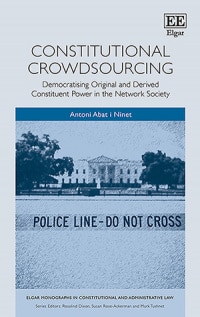
Constitutional Crowdsourcing: Democratizing Original and Derived Constituent Power in the Network Society by Antoni Abat Ninet, a Book Review – Part II
[Editor’s note: this is the second of two posts featuring the book Constitutional Crowdsourcing by Antony Abat Ninet, (Edward Elgar Monographs in Constitutional and Administrative Law, 2021)]
One of the main arguments that the book focused on is the constants for “Rights and Freedoms” and the “State and Society” provisions are positive and statistically substantial for the former, showing that draft articles related to these two subjects were more likely to change based on public response. In contrast, the coefficient for “Independent Bodies” is negative and statistically momentous, signifying that provisions related to this topic were less likely to change based on public demand. Thus, the outcomes suggest that it’s crucial for the constitution to address common demands, such as rights-related text. Public concerns that are raised frequently and vocally are more likely to be included in the constitution. Also, both control variables for contentiousness of each article have positive links with the likelihood of change, but this connection is momentous only for state-owned media coverage. This is imperative because contentiousness of provisions can be a perplexing variable that disturbs both the likelihood of almaslahal‘amah (public interest) in the issue and the likelihood of change. The media tends to cover provocative provisions more often and this increases the probability that online participants took an interest in various articles through votes and commentaries and the prospect that numerous iterations of an article were needed before pact could be reached. Although public news coverage has an important connection with the chance of change, its association with public observations and votes is close to zero, demonstrating that contentiousness of provisions is not a momentous cause of the result. In fact, the important correlation between State News Coverage and the prospect of change in the draft could be due to the fact that when provisions change more often, they would result in more reports by the public media platforms. In other words, the cross-level contact term has a positive sign, meaning the effect of the rights and freedoms provisions on the relation between the online vote and constitutional change is optimistic and therefore the chance of change rises if draft provisions are related to rights and freedoms. Not only the difference between rights and freedoms and other articles is expressively higher for positive online votes, but also the estimation is more precise. Yet, this, should not cast doubt on the implication of the findings on the role of online votes in prompting different constitutional provisions or texts.
Mexico as a Case Study – The book notes, that the enactment of the first local Constitution in Mexico is to be seen theoretically as another landmark towards democratization. But a multifaceted local political scenario and a national distrust in government raised some inquiries about the real utility of a new constitution for Mexico. In January 2016, both chambers of Congress approved a constitutional amendment, that would grant Mexico City more autonomy regarding federal authorities (not sovereignty), through its first Constitution. This accomplishment was the result of a dubious negotiation process among political parties with almost no civic participation that threatened a lack of legitimacy of the Constitutional Assembly, and in general, in the whole constitutional process. The book argued that the initial perspective to generate social participation in the drafting process is to advance a collaborative editing tool where members of the Drafting Group would post essays on themes with comments and feedback generated by citizens and experts (a mechanism that would channel views, notions, and suggestions generated by the people about the Constitution). The result was a digital platform used to design both an informative resource on the constitutional process and to serve as a tool that would endorse civic participation and integrate all citizen contributions to the constitution.
Within the drafting process numerous questions on sensitive topics (e.g., distrust in government; corruption; transitional justice; human rights violations, etc.…) could be considered as intricate as constitutional matters prove to be unappealing to a general public. Thus, to generate a comprehensive and rich call for proposals, it is significant to explore alternative participation channels in addition to the classical collaborative editing trend to crowdsource. So, this case study showed robustly, that the collective reflection process – always – envisioned to start in a platform emerged in many articles of a constitutional itinerary. It’s a pioneering collaborative editing tool and it may become a stage that would funnel different types of citizen input towards the co-creation of a constitutional plan. This platform should be active, so that even if participatory channels are open, individuals won’t occupy them unless they’re given diverse instruments to express their opinions – mechanisms that match their levels of public engagement – and interest in public affairs. A strong believer in open government, sometimes realize that the lack of extensive interest in the joint editing tool came as unsatisfactory but rather unsurprising news. When talking about the future of co-creation apparatuses and processes in public affairs, and maybe the future of open government per se, it’s important to think whom these tools and processes are intended for. If not, the gap between the complexity of the tools and the real common (public) interest they generate to citizens will just keep getting greater, and the open government plan might burst to dissatisfaction in times of democratic fizziness, just when it is desired.
In conclusion, Ninet’s book shows that online public participation in various countries globally is effective and public deliberation affected the prospect of constitutional change. Also, the consequences point to the conditions that make participation effective: popular demands are accounted for as long as they are made more frequently, and more significantly, as long as the political parties honor their ex ante agreements. When the public agrees on the most critical matters and makes reliable demands on constitution drafters, there remains little room for ignoring those demands. Hence, the questions of most concern to the public that are most commonly and loudly needed are more likely to find their path into the constitution. Most important is a prior promise (consensus) among elites over the proposal of the constitution and the political institutions. It is generally well-known that, any constitutional crisis and the political clash that arose came as a result of the failure of the two major opposition groups (e.g., Democrats v. Republicans; Islamists v. non–Islamists) to reach a compact consensus.
The book concludes that without a solid deal and a road map for transition, each group will fight to ensure its political stability and future survival. Accordingly, rather than attempting to rescue the transition process towards democracy and constitutional legitimacy via bargaining with the opposition, each group sets out to grasp power from the other by resorting to any means or ways possible even if it meant bringing back dictatorship into politics (e.g., Brasil). The political antagonism between different/opposing groups will lead in the end, a specific group to alienate others and to write a constitution that reflected the former’s ideology. It should be noted that the boycott is a turning point in the constitutional process that prompted an all-out political clash. The constitutional design means the initial plan for the constitutional process and that is responsive to public demands, and always indicates that online public input is effective as long as the initial agreement is honored. Public input is constantly rendered unsuccessful when all channels of communication and compromise between the two opposing parties fail and end up in public unrest. Most case studies cited in the book demonstrates that, given these conditions, public deliberation can affect the drafting of the constitution. Yet, consulting citizens is less about what goes into the constitution and rather how the public is involved in the process. Public contribution is a democratic practice per se, which is very vital in transitional societies with long histories of totalitarianism and tyranny. Such participatory processes permit for democratization of popular sovereignty, and citizens can participate in a democratic experience where they have a fundamental role in the writing [and the enactment] of their constitution.
Throughout the 160 pages of the book, it is emphasized that the Constitution making after the Third Wave of democracy has changed to echo the normative alarms related to “crisis of representation” related to delegative and competitive concepts of democracy. The “Third Wave of Democracy” refers to a global surge in democratization that occurred predominantly from the mid-1970s to the early 2000s. During this period, many authoritarian regimes transitioned to democratic forms of government across Latin America, Eastern Europe, Asia, and parts of Africa and the Middle East. Key factors contributing to this wave include the fall of dictatorships, pressure for democratic reforms, and the spread of ideas facilitated by globalization and advancements in communication technology. While the Third Wave brought about significant democratic gains, it also faced challenges and setbacks. Some countries experienced democratic reversals, where initial democratic reforms were rolled back, or transitions to democracy were incomplete, leading to hybrid regimes or authoritarian relapses. Hence, the Third Wave of Democracy represents a period of profound global transformation, where democratic ideals spread and took root in societies across the world, reshaping political landscapes and inspiring movements for political change.
Participatory constitution making, as such, is an evolving practice and progressive countries use some modes of common engagement when drafting a new constitution. It concludes that crowdsourcing during the deliberation stage of the constitution drafting and shows that online public feedback expressively affects the prospect of constitutional changes. This result may be specific to particular countries and cannot be generalized unless an inclusive cross-national test of citizen input and constitutional changes is achieved. Popular preferences would be reflected in the constitution if citizens approve on the most striking issues and convey them more recurrently, and as long as there is an ex anteijma‘a among constitution drafters on the overall design of the constitution. This outcome speaks to the democratic theory by presenting evidence that public constitutional deliberation can affect the constitutional drafting.
After decades of autocracy, the constitutional process in various nations around the world allowed citizens to contribute to the authorship of their constitution and to convey their desires and hopes to the Constituent Assemblies. The statistical results presented – in many examples – prove that as the online public approval over draft articles amplified, the anticipated provisions were less likely to change and if the online public censure increased, draft articles were more likely to change. Further, the results propose that comments/feedbacks on articles concerning individual and civil rights were more likely to be positively merged in the constitution compared with those about political institutions. In case of political congestion or stagnation among political boycott, online public responses were less likely to impact the content of constitution. The failure of drafters to reach a solid pact over the constitutional design destabilized their efforts in engaging the public in a democratic constitutional process and paving the ground for transition to democracy.
Eventually, any fragile promise broke down and ruined the participatory constitution-making process, however, long negotiations between different political parties allow for less political disharmony and a more operative participatory process. If all parties are suspicious of each other from the beginning, input did make a difference when all sides are eager to play by the rules of the transition process and keep engaging with the general public. But some cases, show how a risky balance among elites can smash and leave the citizenry excluded from the process. Five lessons seem mainly prominent for any nation intent on trying this at home:
Plan Carefully: this does not go without saying, because, although the crowdsourcing moment could have led to a worthy purposeful and deliberative feedback loop between the crowd and the constitutional powers (councils/assemblies), the latter did not always seem to have the time, tools, or training needed to process carefully the crowd’s contribution, explain its use of it, let alone return reliable feedback to the public.
Publicly Justify/DebateProcedural Design Options: a constitutional process purposes to be integral (or thorough), inclusive and transparent, so must the reasoning behind crucial design choices. It might truly have been a good clue to make a discussion of the process part of a national forum or use crowdsourcing at that early stage too.
Be Aware of The Requirements for Change: circumstances for constitutional change are themselves normally not up for discussion (dictated by the current constitution), it might have been wiser to go for the less ambitious goal of reviewing a few vital articles than rewriting the whole charter. This will be different for a state writing a constitution for the first time.
Do Not Try to Evade Entirely Other Prevailing Representative Institutions: constitutional authorities saw themselves as strangers to the system fighting deep-rooted elites. That attitude may have played out well just after disasters, but on the long run it damaged their legitimacy and jeopardized their task. The success of any constitutional process is basically dependent on uniting key political actors and upholding legality all over.
Use Experts Intelligently: the role of expert consultants in the process should be illuminated and a practical division of work worked out with (mainly constitutional assemblies’ members). Including attorneys/legal scholars in the wording of the constitutional proposal is perhaps a good idea (to ensure language/interpretation accuracy and compatibility with universal norms). Sometimes, it ends up twisting the drafters’ intent (a violation of popular sovereignty), but they accurately deteriorated the quality of the proposal.
Some experiments have unquestionably confronted the interpretation that a constitutional process must be exclusionary and mysterious, creating a precedent for a more democratic design. Let us hope – as the book concluded – it will inspire more tryouts of the kind in the near future.
Constitutional Crowdsourcing: Democratizing Original and Derived Constituent Power in the Network Society by Antoni Abat Ninet, a Book Review – Part I
[Editor’s note: this is the first of two posts featuring the book Constitutional Crowdsourcing by Antony Abat Ninet, (Edward Elgar Monographs in Constitutional and Administrative Law, 2021)]
Constitutional Crowdsourcing: Democratizing Original and Derived Constituent Power in the Network Society by Antoni Abat Ninet, provides empirical evidence from online citizen feedback within various constitution(s). The book demonstrates that despite the normative skepticism about implications of participatory constitution making, citizen participation matters. The book argues that using data of online votes and comments on the constitution, make the draft provisions with higher public approval less likely to change and those with lower approval more likely to change. It argues that the provisions related to rights and freedoms are more likely to change based on online public input. These arguments highlight the conditions under which participatory constitution making becomes more operative. First, ijma‘a (consensus) among citizens over the most prominent matters increases the prospect that those questions would be positively incorporated in the constitution. Second, without ex ante elite agreement over the constitutional design, it becomes problematic to account for citizen proposals amid political clash between elites. Ninet argues that the essence of any constitution is to capture a set of fundamental principles and rules that will outline public life and interactions within a society for any given moment in time. Drafting constitution requires a collective reflection on who “We the People” are, and what we imagine for our nation’s future.
In the past few decades, constitution-making processes have been changed to give “We the People” a literal meaning. The manuscript argued that various new constitutions promulgated recently, and many of them have incorporated at least one form of citizen participation, ranging from the election of constitution drafters to direct citizen input and public deliberation over the content of constitutions. These participatory processes legitimize the constitution by giving the people a role in the writing of their constitution. This book also emphasized that an emerging perspective is to open the deliberation phase of constitutional design processes to the public and to permit citizens to debate the text, propose provisions, and(or) add amendments to prevailing drafts. Several nations, including Iceland, Mexico, Egypt, and Tunisia, have boarded on cutting-edge, online actions to crowdsource public input on the content of the constitution. The book presents a precise response(s) to queries like, do these new initiatives authentically channel citizen preferences? Does “the nation write its own constitution”, as suggested by many Constituent Assemblies around the globe? Using a dataset of constitutional drafts and online public votes and suggestions, it tests whether online public debate – especially for countries during transition towards democracy – in the constitution-making process had any impact on the likelihood of constitutional draft changes. Several cases are instructive for constitutional reform around the world through a participatory process (e.g., Egypt is the first in the Middle East after the 2011 Arab Spring uprisings). Understanding whether participation was operative/effective or under which circumstances it can be activated can provide insight into the causes of its failure and how its ill fate could have been prohibited.
In response to the consequential frustration and power imbalances/inequalities, the book argued that platform users created external tools for communication and platform monitoring, as grassroots alternatives to an improved platform design. Analogous solutions emerged in most paid crowdsourcing platforms, regardless of top down controls. This attitude of asymmetric governance destabilizes the expected future of paid crowdsourcing. In contrast to the top-down governance structures that paid crowdsourcing platforms presently use, the author explored a bottom-up approach: open source governance (online or physical) communities. He describes a crowdsourcing stand where constituents have full access to governing documents and participate in drafting/writing legislation through an iterative community process akin to how open source software is developed. Ninet highlights throughout the pages of the book, that crowdsourced democratic deliberation offers an actual bridging of these approaches into a mechanism driven by participant stakeholders. He argues that, a governance document intended to generate a formal process for paid crowdsourcing marketplaces that permits and manages operational changes, driven by its users’ preferences will be needed to meet future democratic transitions. This document (the constitution) provides a set of legal norms governing the community and a mechanism for those laws to evolve through an amendment process. The constitution frees the platform owners to make any design changes or improvements, as long as they do not violate the constitution or its amendments.
It should be noted that open source governance structures exist in political governance societies. Nevertheless, collective efforts in crowdsourcing marketplaces have focused their efforts outside of the marketplaces per se, as many efforts have been distributed and maximize individual independence rather than collective effectiveness. Asymmetric trust and power in crowdsourcing constitutions challenge the process of governance by changing the design of the platform (mediating issues). The manuscript argues that constitutional design underscores the crucial challenges of governance in crowdsourcing marketplaces: balancing power between the stakeholder groups, and providing an official, platform extensive conduit for debate. To accomplish this, it is essential to develop mechanisms for making decisions about changes influencing the stakeholder groups and for dealing with conflicts. Additionally, it is critical to set the tone of governance by providing initial all-embracing community values. One of the most significant arguments proposed by the author is that in order to attain a democratic transition, it’s very important to ratify an initial constitution that formally specifies a process for decision making, conflict resolution, and a protocol for its own evolution through amendments. The constitution is setup with initial community standards which are designed to evolve/mature.
In terms of the principle of Separation of Powers, the book argues that crowdsourcing platforms are normally interested in making design decisions permitting them to endure developing and improving the platform to remain competitive. Ninet argued that the constitution aims to support democratic deliberation among its users, while also affording adequate technical freedom for the platform to develop quickly. As a result, the active individuals are the voting constituency, submitting ideas/notions, developing amendments, and voting on which ones to add to the constitution. On the other hand, the platform team is tasked with operationalizing the modern version of the constitution through technical deviations. It should be noted that the constitution evolves via an amendment process – as amendments develop over time, and entail a practicability check – but they are eventually submitted for a vote from the community. New philosophies can be added incognito by anyone to a public idea listing, then the listing supports discussion and empowers platform stakeholders to designate interest by upvoting. After reaching an upvote edge, the idea evolves into a possible amendment, and an intended task force sets out to draft changes to the constitution formalizing the notion and also to ensure it adheres to the updated constitution.
In the last few decades, practitioners and public law scholars alike have endorsed the general public’s direct participation in articulating and debating constitutions, claiming that the nature of the constitution-making process has serious consequences for constitutional outcomes. This emphasis on the process is deep-rooted in theories of participatory and deliberative democracy that underscore citizen participation and deliberation as circumstances for democratically legitimate political processes. The book argues that participatory and deliberative schemes are principally established in response to the rising criticisms of traditional democratic institutions and to fix the disconnect between citizens and decision makers. While participatory and deliberative concepts of democracy (e.g., debate/deliberation, voting and amendment processes are conducted on a forum with some minor modifications to enable specific voting features) both target democratic lawfulness and policy efficiency, they diverge on the means for achieving these objectives. Theories of participatory democracy emphasize the status of inclusion and political equality for policy efficacy and legitimacy. Participatory democrats underscore the fundamental value of participation as an educative and progressive process. Participation allows citizens to gain a “practice of democratic skills and procedures.” Although the educative feature of participation remains vital, legal scholars and political scientists have progressively stressed its influential value as a means against arbitrary power. As such – and as the author argued – democratic innovations in citizen participation redraw the classical forms of decision making found in representative systems by permitting citizens to have more impact in the political decision-making process by offering their own expertise.
Ninet argues that despite skepticism about the democratic implications of participatory constitution-making processes, the design of constitution-making processes can affect both the content and the legitimacy of the final document. He suggests that constitutions produced through more democratic processes tend to be more democratic. The conclusions on the effect of citizen participation on content of constitutions are not decisive, but several case studies point to the influence of participation on the constitutional content. For example, a comparative case study on many constitutional processes (e.g., Tunisia, Kenya, South Africa, Colombia) highlights that more participatory processes tend to create constitutions with more democratic framework including more provisions related to fundamental human rights defenses. Moreover, that participatory processes resulted in constitutions with provisions on social and economic justice and corruption that were needed by citizens, and also show that processes including referenda normally produce constitutions that are more likely to have numerous rights provisions. Hence, the book argues – successfully – that the more the role of citizens in constitution making upsurges, the more the quantity and quality of rights afforded by the constitution increase, advance and improve.
Bringing the Constitution Online: United States, Europe and Beyond – Several European countries along with few in the Middle East (Tunisia, Egypt) were among the first(?) countries in the world to use online means for constitution making. One of the most significant chapters is entitled “Crowdsourcing and Constitution-making.” In this chapter, Ninet argues that, in an effort to make constitutional processes as participatory as possible, crowdsourcing creativities have become a platform for public participation in the constitution-making process. After the Icelandic Constitutional Council pioneered crowdsourcing in 2011, other nations such as Egypt and Tunisia – after the failure of the 2011 Arab Spring – have used comparable attitudes to engage their citizens in the deliberation phase of constitutional processes. In this context, crowdsourcing could be defined as “that the constitution as the process of posting the draft constitution [or parts of it] online on official websites and[or] social media [p]latforms/webpages where citizens can propose/suggest recommendations to the draft and[or] vote on it.”
In this chapter, the author argues that generally, there is a prevalent optimism concerning the participatory potential of the internet. Although crowdsourcing cannot resolve the low levels of participation and the self-selection prejudice/bias intrinsic in participatory processes or “participation distortion,” online deliberation can eradicate geographical obstacles and bring a great variety of groups into the national deliberation. Moreover, no matter the numbers, participatory processes are significant because they give all citizens equal opportunity and right to participate and influence the final outcome. This chapter is critical from a comparative perspective. For instance, in Egypt, people participated in the crowdsourcing initiative, and made several contributions in the form of comments and/or voting “Like” or “Dislike” on proposed drafts for public review and feedback (e.g., collect and separate public feedback based on the means through which suggestions were submitted; documenting suggestions members of the public made during the deputies’ personal and those received via phone calls, fax, mail, e-mail, or written suggestions handed directly). The Egyptian case is unique because each draft article (provision) was posted online and changed several times following citizen’s feedback, as opposed to other cases where citizens could comment on only one draft (e.g., Tunisia). Thus, the Egyptian model, presents an extraordinary feedback loop of online public input and constitutional changes.
The “Crowdsourcing in Constitutional Interpretation and Control,” is another significant chapter in that book. It deals with numerous transitional countries with an authoritarian heritage, precisely when there is power imbalance between opposing groups. Accordingly, agreement among citizens over the most prominent issues can increase the prospect that those matters would be reflected in the constitution. The legacy of fascism and the abuse of citizens’ rights and freedoms in various places around the world, including the Middle East (and Ukraine at the moment) led to public concerns about provisions relating to citizen rights and freedoms and the wider bond between the state and society, as opposed to provisions regarding independent and regulatory bodies or public authorities. In these cases, the public obviously conveyed their concerns about these provisions, and their recommendations pushed change in articles affecting to rights. Also, citizen participation should follow ex ante elite consensus, as this shows the importance of agreement, and elite agreement in particular, for successful constitution making.
This chapter argued that the consensus among elites is even important for an effective participatory process. When conflict emerged among drafters, citizens lost their leverage. If there is no prior agreement on the broader design of the constitution, it becomes more problematic to integrate public proposals amid dispute or contention. In moments of transition, building a robust political will and trust among various political groups is one of the crucial initial steps for democratization, and whether a consensus occurs from the onset or it is preserved through the process has grave consequences for this trust building. In many nations, liberals and conservatives (e.g., Islamists and non-Islamists in Egypt) failed to sustain the risky agreement they reached early on in the process (e.g., 2012 ex post facto Constitution!). The absence of agreement, harmony and trust only made these opposing groups more doubtful of the other, ensuing in gradual restoration of undemocratic rules and loss of receptiveness and accountability to the public/citizens.
[To be continued]
Mindful of the World: “A Cosmopolitan Jurisprudence”
[Editor’s note: this is the final of four blog posts featuring the volume “A Cosmopolitan Jurisprudence: Essays in Memory of Patrick Glenn”, edited by Helge Dedek, Cambridge University Press, ASCL Studies in Comparative Law, 2022]
It has been a long journey from the first tentative ideas to the publication of this collection in memory of an esteemed colleague and beloved friend. The first working title for the collection, alluding to Patrick Glenn’s indefatigable idealism, was “Sustainable Diversity in Law” – borrowed from the original subtitle of his book Legal Traditions of the World that Glenn himself dropped in later editions. However, along the way one specific theme gained prevalence, namely that Glenn’s ideas went beyond targeting the traditional comparatists’ fixation with state law but ultimately sought a novel way of thinking about law writ large: the bold ambition to conceptualize law entirely through the experience of plurality and diversity.
For Glenn, “Comparative Law” was the inevitable disciplinary home to develop such a pluralistic vantage point, a mode of thought accessible to those who defy being intellectually circumscribed by only one national tradition, one methodological framework, one value system. Embracing the relativity of perspective would open the possibility of recognizing oneself in the Other and would pave the way to an understanding of “comparison” beyond traditional “comparative” analysis. The aim was thus eventually, as Glenn put it, a “cosmopolitan legal theory” that would hold up a mirror to conventional legal thought, and “play the role of a ‘critical theory’ in presenting alternatives to current forms of normativity, whatever their forms” [H.P. Glenn, Differential Cosmopolitanism, 7 Transn’l. L. Theory57, 69 (2016)].
This fundamental challenge to methodological nationalism might just be the most thought-provoking aspect of Glenn’s work, and potentially the most relevant to the many ongoing similar discourses across various disciplines. This ambition and audacity to think about law differently, in a genuinely “cosmopolitan” way, inspired the collection’s eventual title: “A Cosmopolitan Jurisprudence.”
In this context, (cosmopolitan) “jurisprudence” seemed the more fitting label than that of a “theory.” While we associate, in casual usage, “jurisprudence” with any kind of scholarly treatment of law, the semantics of prudence and prudentia are historically connected to a scholarship that is characterized by learnedness and judiciousness – the reigning paradigm of legal scholarship until it began to be replaced by scientia, science, as the paradigm for all university disciplines. In addition, prudentia, used to translate the Greek “phronesis,” has traditionally been tied in Western philosophy to forms of intuitive, practical wisdom, gained from experience [see e.g. D. Randall, The Prudential Public Sphere 44 Philosophy & Rhetoric 205 (2011)]. Glenn’s intellectual trajectory was that of someone trained in the law who felt compelled to step outside traditional disciplinary boundaries by the actual experience of diversity and otherness, experience gained as a comparatist and traveller of the world. Intellectually, he was an avid traveller as well: uniting shards and pieces from various works and disciplines into an original pluralist mosaic that made sense of this experience. It comes to mind that, as Ulf Hannerz [Cosmopolitans and Locals in World Culture, 7 Theory, Culture & Society237, 239 (1990)] once observed, “cosmopolitans should ideally be foxes rather than hedgehogs.”
The visceral appeal of such “phronetic wisdom” is probably one of the reasons why the metaphoric reference to art, especially the piece “Black Whole Conference” by Montreal artist Michel Le Broin, eventually took on such a prominent role in my own introductory chapter. Of course, as we all know, another aspect of this unconventional nature of Glenn’s work was that it was open to criticism on many fronts, and that critics at times were harsh in their judgment. It seems to me, however, that it is particularly this quality of triggering the urge to voice disagreement, this “irritating” quality that will keep fuelling important conversations and inspiring other unconventional ideas. Accordingly, the collection was never intended as a hagiography but as a respectful yet critical engagement with Glenn’s ideas – in other words, as the continuation of the kind of intellectually honest conversation that Glenn himself enjoyed so much in his lifetime [cf. A. Halpin, The Application of Bivalent Logic, and the Misapplication of Multivalent Logic to Law, in H.P. Glenn & L. Smitheds, Law and the New Logics 208 (2017)].
I believe, for example, that Glenn’s focus on the concept of “tradition” is an extremely valuable stimulus to further explore and take more seriously the discursive characteristics of “law”, shifting the perspective onto the historicity of the methodological nationalism in law itself – a move that allowed Glenn to speak, counter-intuitively perhaps, of the state itself as a tradition.
However, I find unconvincing that, in their anti-statist and anti-positivist thrust, Glenn’s ideas mostly tune out the dimension of law as power, as force, as violence. In Glenn, this is not just a matter of analysing “law” from a particular perspective that sheds light on its discursive nature in a way that positivistic or sanction-oriented theories of law will not. Rather, Glenn derives an odd normative twist from the analytical finding that each tradition is, essentially, communication: “communicative action” as such can navigate and overcome conflict. For Glenn, introducing the tradition-concept itself thus creates an epistemological framework for the (re-)conciliation of, and between, traditions. Traditions are, due to their communicative structure and nature, by definition “commensurable” and thus open to dialogue [on another aspect of this normative bend, cf. M. Krygier’s blog entry Thinking too well of traditions].
Yet in a global order characterized by a post-colonial hegemonic hierarchy, the challenge of (re-)conciliation presents itself specifically against the backdrop of a history of injustice and violence, and in the context of conditions of inequality in which recognition of the non-hegemonic tradition is never fully realized. The bias against acknowledging the role and presence of violence in all of legal discourse ultimately manifests itself in a lack of sensitivity towards the epistemic violence inevitably implied in the assumption of “commensurability.” That is at least the case as long as it is not acknowledged that the “common measures” upon which “commensurability” is predicated, (that is, the ‘universal’ language and the concepts that determine the framework of commensurability) typically are those imposed by the hegemonic tradition [see e.g. J. Tully, Strange Multiplicity: Constitutionalism in an Age of Diversity 39 (1995)].
Going forward, a “cosmopolitan jurisprudence” (or even “cosmopolitan critical theory”) will have to acknowledge that certain non-Western, especially Indigenous traditions, completely elude Western imagination and verbalization. As Canadian Indigenous scholar Aaron Mills has suggested, an assumption not of universalizing commensurability but rather of radical incommensurability might be therefore the truest form of recognition [see A.J. Mills, Miinigowiziwin: All that Has Been Given for Living Well Together: One Vision of Anishinaabe Constitutionalism, 45 (2019)].
However, despite its flaws, Glenn’s “cosmopolitan jurisprudence” was based on the uncontestably right intuition: to necessity to challenge the methodological nationalism in law that is such a strange anachronism in our global age. Phronesis/prudentia, suggested another unconventional thinker concerned with breaking down boundaries between traditions [Thomas McEvilley, The Shape of Ancient Thought 609 (2002)], could also be translated as “mindfulness”:if Glenn’s jurisprudence has contributed, even just a little bit, to making us more mindful of this necessity, to making us jurists more mindful of the world, we are all better for it.
Thinking Too Well of Traditions
[Editor’s note: this is the third of four blog posts featuring the volume “A Cosmopolitan Jurisprudence: Essays in Memory of Patrick Glenn”, edited by Helge Dedek, Cambridge University Press, ASCL Studies in Comparative Law, 2022]
Often the words we use are at the same time commonplace and weightless; we are comfortable using them and they loosely, often usefully, direct the flow of verbal traffic one way or another along paths we and others can understand. But they commit us to little. ‘Tradition’ is commonly mentioned in that way: something to do with things handed down from the past, but not much more.
Sometimes, however, when taken up by a stringent thinker, the same words get content and depth; at their deepest they come both to embody a theory, or at least a considered view, and contribute in specific, even unsubstitutable, ways to larger theorising. Think Marx on class, or Weber on bureaucracy. In Patrick Glenn’s prolific and wide-ranging contributions to comparative law, ‘tradition’ becomes such a concept.
Glenn was dissatisfied with the standard taxonomic characterisations of law into systems, cultures, families, nation-states, etc. He emphasises the indispensable, ineradicable, normative presence of the past in law, and thus rejects temporally and otherwise parochial ‘time-slice’ characterisations of ‘legal systems’ or ‘cultures’ and such, which suggest that they all might have started yesterday or that it wouldn’t matter if they hadn’t. He is hostile also to post-Western-Enlightenment slightings of the traditional sources of form and content in societies and legal orders, modern as much as those relegated to benighted, custom-dominated, ‘pre-legal’, ‘traditional’, pasts, or presents in ‘less developed,’ usually southern, climes.
For Glenn, the traditionality of law is key, and he is surely right. In almost every legal ‘system,’ the maintenance of a normatively present past is attended to with a diligence matched only in institutionalised religions. This is no accident. In law, traditional inheritances are the unreflected-upon context and medium of reflection, imagination and action. What these present-pasts are made up of – statutes, interpretations, court judgments, the opinions of scholars – differs greatly among legal orders. Overarchingly, particular forms of what Clifford Geertz calls ‘legal sensibility’ also endure within traditions and differ, sometimes dramatically, between them. The pervasiveness of such pasts, both real and imagined, their architectonic significance in the present of law, can scarcely be exaggerated.
Analytically (and legally and sociologically), then, Glenn’s is a profound and enriching insight, and he is profoundly attached to it. But as often happens with iconoclastic enthusiasts, at times his fondness for his subject overreaches. For he attributes virtues to traditions, ontologically as it were, that are not always there or theirs.
Glenn sets a lot of store by a quite specific narrowing of what counts as legal tradition: it is past informationand nothing more. That is important because information is available to anyone, does not exclude others as ‘systems’ and ‘cultures’ do, is open for appropriation all over time and place. As Glenn writes, information ‘does not control legal practice. It is tolerant of argument … while allowing peaceful resolution of disputes,’ ‘tradition conceived as information has no borders’ ‘the flow of information is ultimately uncontrollable; closure is never complete.’ He introduced the attractive metaphor for legal tradition of a ‘bran-tub’; reach in and choose your prize.
But tradition is always more than mere information. Members of traditions never simply choose between the bits of information that come down to them. In a real sense, as Gadamer has written, we ‘belong to elements of tradition that reach us.’ For, beyond the information they transmit, traditions, particularly institutionalised ones like law, are managed by traditionally authorized guardians concerned that some things be in, some out; some normative, others just simple information; some information, others just noise. And if I am a judge in a legal tradition, or a citizen in search of a result, I hope the law is not random information. I want to be able to know it when I need to. Where things work as they should, many legal practices are designed to make that possible. Of course it’s not a simple matter, and there is always room for interpretation, but if it’s a lucky dip we’re in bad shape legally. And when the law is not as I believe it should be (for reasons traditions say a lot about), I or someone is likely to be involved in trying to ‘massage’ (Glenn’s term) the material to have it interpreted one way or another, implemented one way or another, taken more or less seriously as a normative element in their life-world. If all this sort of work is not happening to the ‘information’ in a tradition, you don’t have a tradition; just information. For imposed ways of handling (including ‘massaging’) traditional information are not just unavoidable ‘corruptions’ of traditions, which Glenn acknowledges. They are constitutive parts of their nature.
Tradition, then, is never ‘simple’ information. Being normative it is always ‘information plus’ and the ‘plus’ does a lot of work. That being the case Glenn’s beguiling images of free-flowing rivers or randomly assembled and chosen bits of information in a bran tub, which might make plausible Glenn’s contrasts between inherently borderless traditions and hermetically sealed systems and cultures, is overdone and does not support the congenial characterization he draws from them.
Nothing in the nature of traditions tells you how they will behave; it is as little contrary to their nature to be hostile to other traditions, or to sects and heretics within the great traditions as it is to be tolerant of them. As Glenn himself notes, ‘Tolerance is not easy, which may be why there is a tradition of intolerance.’ (Glenn, Legal Traditions of the World, n.5, 53). Indeed there is; indeed there are. Many, and their lives have been long. I doubt that even the most skilled massaging of the concept of tradition is likely to end that any time soon.
None of this undercuts the significance of Glenn’s contribution. We should acknowledge that law is typically founded on and in traditions, simply because that is a fact, and an important one. We can also learn much from his learned, bold, wide-ranging and bold application of the concept and exploration of the phenomena. I fear, however that to acknowledge these virtues will do little to advance the accommodations among traditions that Glenn admirably favours. Nor does it necessarily block them. They still have to be promoted on independent grounds, not because to act conflictually or exclusively or arrogantly in relation to other legal traditions is in some way to betray (or corrupt), or for that matter to honour, the very nature of legal tradition itself.
Nothing in the nature of traditions tells you how they will behave; it is as little contrary to their nature to be hostile to other traditions, or to sects and heretics within the great traditions as it is to be tolerant of them. As Glenn himself notes, ‘Tolerance is not easy, which may be why there is a tradition of intolerance.’ Indeed there is; indeed there are many, and their lives have been long. I doubt that even the most skilled massaging of the concept of tradition is likely to end that any time soon.
Thinking well of traditions
[Editor’s note: this is the second of four blog posts featuring the volume “A Cosmopolitan Jurisprudence: Essays in Memory of Patrick Glenn, edited by Helge Dedek, Cambridge University Press, ASCL Studies in Comparative Law, 2022]
The most controversial theoretical contribution to comparative law by the polymathic Patrick Glenn in his LegalTraditionsof theWorldwas his effort to get us to think well of tradition(s). For him, the key to tradition is the idea of information, that which is brought from the past to the present, in a particular social context. It can include stories, concepts, beliefs, facts, symbols, values, political theories, heuristics and, if not actual institutions, at least ideas about institutional objectives, design and significance. The variety of information captured will increase as the tradition increases in size, each generation capturing its own understanding of the tradition. The pool of information captured by the adherents of a particular tradition cannot be entirely controlled, but a tradition stays alive through massaging i.e.- by being called on selectively (the massage is the message?) Above all, however, for Glenn, legal traditions do, can and should respect each other. Elaborating this argument was part of a project of building what he called ‘sustainable diversity in law’, a necessity for the peaceful coexistence of different ideas and peoples.
Realising such an aspiration is increasingly urgent as so many groups are currently reacting to globalisation by (re) emphasising connections with the past and appealing to supposedly long-standing distinctive religious and national bonds and identities. But it begs a series of questions. How far can tradition help to facilitate necessary changes rather than stand in their way? What happens to those who challenge tradition? When do traditions in fact respect each other, when do they instead seek to predominate?
Glenn tells us that major traditions achieve complexity because of their proven ability to hold together mutually inconsistent sub-traditions. Butif it is intuitively plausible to think that the complexity of tradition makes necessary a tolerance of potentially conflicting ideas, at least some of the time, it is less obvious that the same applies to the relation between traditions. Glenn admits that a tradition can take specific measures to protect its underlying or basic elements, using means that range from a simple ethical obligation to remember, to instruments variously known as heresy, treason, or sedition. But he asserts nonetheless that the authority of tradition is persuasive only. It allows for dialogue and normative engagement, as opposed to hierarchical dominance.
Some of Glenn’s claims may depend more on definitional stops than on empirical findings. But if we are to make progress in assessing them (and further his admirable goals) we require more case studies of how in practice different traditions manage continuity and change, and the ways in which they deal with (other) internal and external challenges. One example of reconciling continuity and change under changing social circumstances is offered by the way the Jewish law tradition (one of those examined in detail by Glenn) revoked and/or reinterpreted the strict biblical rules about the cancellation of loans every seven years. The rabbis, following the suggestion of Hillel, crafted a loophole by introducing a document -the Pruzbul- that would accompany interest-free loans, stating that such loans were to be transferred to the courts. As the law of remission does not apply to loans within the public domain this ground-breaking institution benefited both borrowers and lenders. It meant that borrowers would still be able to access loans because lenders knew their money would be safe despite the arrival of Sabbatical year.
The issue- much fought over by different streams within Jewish tradition- is by what right Hillel sought to circumvent what appeared to be a clear Biblical prescription (one accompanied by a warning that people should not refrain from lending even if they knew they would not be repaid). The more conservative answer explains that, because of changes in where Jews were living at the time of Hillel’s ruling, the Biblical requirement to cancel debts was no longer binding. It was now only supported by Rabbinical authority and hence could be amended by that same authority. More, the change was intended to privilege the higher level-Biblical – necessity to ensure that loans continued to be forthcoming. More radical commentators tend instead to take Hillel’s action as an example of bold willingness to update tradition in the light of changing social needs. They treat his innovation as a purported precedent for similar bold interventions on other fronts which in their view are now crying out for reform. As for traditions being mutually respectful, for outside observers, the exact basis of Hillel’s action is less significant than for insiders. Depending on the starting points of rival traditions, they can be less than generous to this innovation – for example preferring to highlight the persistence of different rules about lending on interest to insiders as compared to outsiders. For some, Hillel’s creative skill in renewing the past in the present is characterised as Rabbinical casuistry in the service of proto capitalism.
Legal Monotheism and Its Discontents
[Editor’s note: this is the first of four blog posts featuring the volume “A Cosmopolitan Jurisprudence: Essays in Memory of Patrick Glenn, edited by Helge Dedek, Cambridge University Press, ASCL Studies in Comparative Law, 2022]
Patrick Glenn’s scholarship does not introduce a ‘concept of law’ or explicitly criticize the concepts of others. Yet, he trusts the findings of a long line of legal anthropologists (and a shorter one of comparative law scholars) showing that in non-Western traditions, there is no distinct line between legal and non-legal forms of normativity (Legal Traditions of the World: Sustainable Diversity in the Law, 5th edn, OUP 2014, 60–94, 98–129, 180–215, 287–315, 319–56). Yet, the method and tools Glenn relies on can be used to look into the Western legal traditions too.
In the West, political and legal theories have long been taking for granted the idea that law is the province of government and government recognized authorities, including the judiciary. They have concentrated on the processes and principles, by which the form and substance of official (State) law are determined, implemented, and enforced. By contrast, many non-official sites of legal production have always existed and still exist (outside and) inside the West. These sites produce rules that may flourish indifferent or in opposition to official law and take the settlement of disputes arising out of the application of those rules outside the ordinary circuits of adjudication. Even though the discussions about the relation between the latter rules (especially those developed by merchants) and official law is one of the most ancient debates of the law, in the last two hundred years the Western positivist attitude has been able to obscure and fence off the multifaceted dimensions of the legal experience from the spotlight of critical investigation, from law schools and from legal textbooks.
The low visibility of these unofficial legal sets in the mainstream debate, however, should not obscure thesignificant effects they can have on social order—and on the efficiency of the concerned markets and dispute-solving mechanisms. Indeed, there are many field studies conducted in different sectors of social life and business activities, showing how in those sectors unofficial law reveals itself as the controlling factor of public and private behaviors. Examples may be drawn from fields as disparate as family, religion, religion-related food, rural communities, the enforcement of commercial contracts surveyed in the local, national and global dimension, concerning e.g. the markets of cotton, diamonds, grain and feed, the online environment, the financial law (M. Bussani, Strangers in the Law: Lawyers’ Law and the Other Legal Dimensions, 40 Cardozo Law Review 3127, 3146 (2019)).
Thanks also to these field studies, in the last decades the unofficial dimension of the law has gained new scholarly traction. Law and society scholars inquire into the social structures that induce compliance, law and economics scholars examine non-State law rules and institutions that allow for efficient and desirable social results, law and psychology scholars scrutinize the motivations that ground loyalty to non-State and State laws, and all (should) profit from the long trodden path of legal anthropologists and from their findings on the cross-cultural features of social ordering, as well as from legal historians’ studies on how private and commercial law has been thriving for ages in the absence of constitutions, almighty legislatures, and State courts orderings.
The overall lesson we should learn from the above scholarship and field studies is that overlooking the sets of unofficial laws we leave behind us a piece of the real legal world that survived to our ignorance in the past and will outlive our current disregard. Unofficial law asks lawyers to ‘stop, look, and listen’ as they approach the boundary of the official legal system. What is enmeshed in unofficial laws are in fact the multi-faceted fabrics of our society, the different existing views of looking at ourselves and the others, the manifold ways of unfolding our loyalties, our identities, and our professional, social, and cultural selves. If we keep looking down on the legal offspring of all this, we miss a cognitive dimension of the law, whose loss, among other things, should urge one to define herself not as lawyer, judge, or legal scholar, but as State-law lawyer, State-law judge, State-law scholar, and nothing more. This is one of the fallouts the battle of definitions about “what is law” carries with itself – a battle Glenn wisely avoided. Searching, debating, and setting borders functional to institutional arrangements that need to keep clearly separated State law from the rest, has proved successful in the last two/three centuries and is a culturally legitimate attitude. The latter’s matrix should be disclosed, though. It is grounded on a series of (neither transcendental, nor immutable, but) historically construed notions, and the refusal to acknowledge it, acting as the ministers of a legal monotheism, reveals nothing but a path-dependent, all-Western-centric, and certainly profitable (also in view of preserving an intellectual and professional status quo) way of looking at the “law.”
Taking stock of the foregoing also explains why a pluralistic, interdisciplinary perspective on law is much needed in order to seize the ways the laws both reflect and structure human relations. Among many other things, Patrick Glenn taught us this. Such a perspective would call into question common views of official and unofficial law, connecting mainstream visions about law within the broader social contexts where laws and justice live, and unveiling the different kinds of loyalties that underlie and support the choices of official and unofficial law mechanisms and actors. To delve beyond conventional wisdom and to better understand the legal dimension through the cultural, social, and professional frameworks in which the laws operate and are embedded, would be both this perspective’s promise and challenge.